EV Battery Recycling in India: How India Recovers Lithium, Cobalt & Nickel
How EV battery recycling works in India: the process, Battery Waste Management Rules 2022, recovery targets, top companies, and market outlook to 2030.
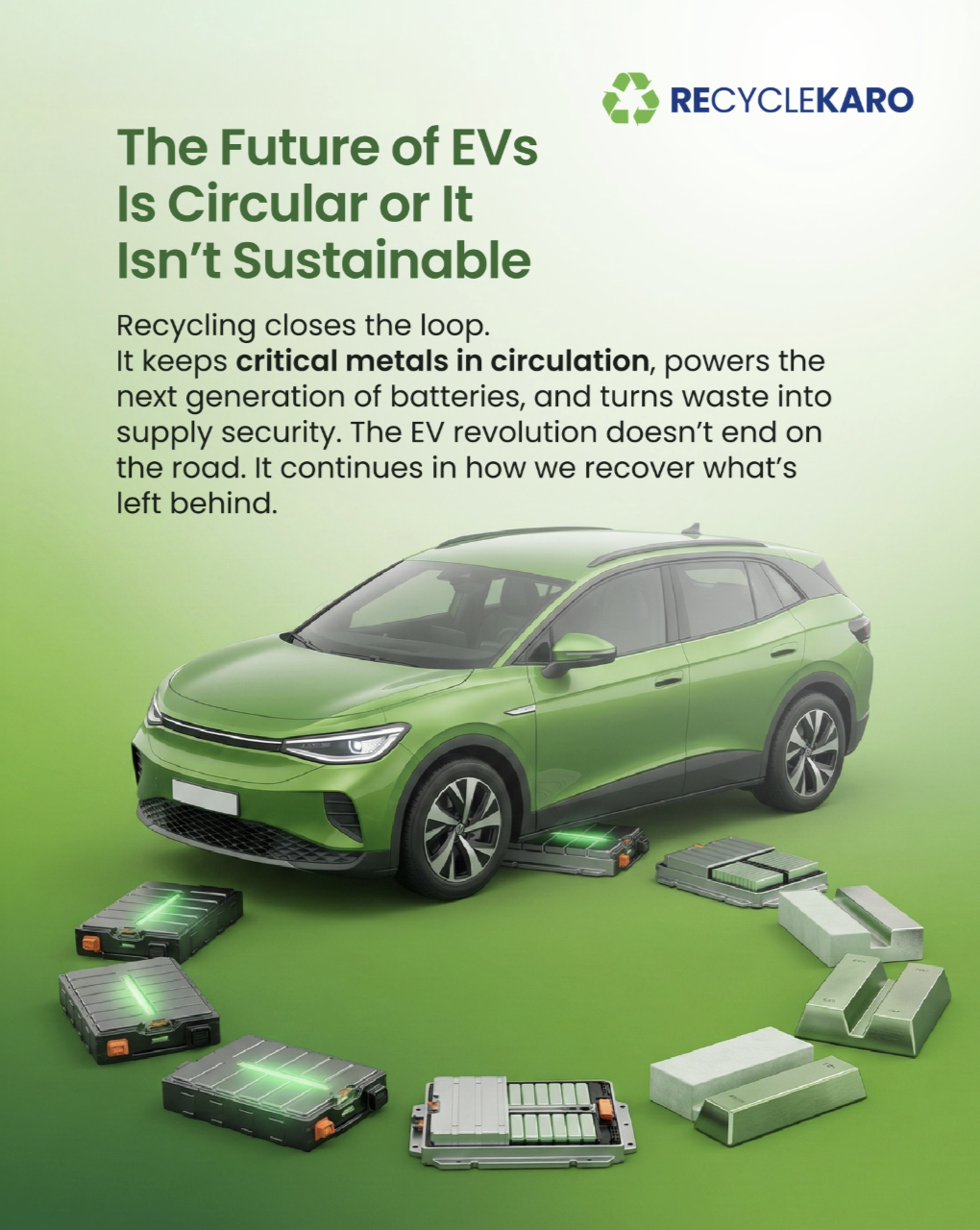
EV battery recycling is the process of recovering valuable materials like lithium, cobalt, nickel, graphite and copper from used electric-vehicle battery packs so they can be reused instead of landfilled.
In India, it is governed by the Battery Waste Management Rules 2022, which require producers to meet Extended Producer Responsibility (EPR) targets, including up to 90% material recovery by 2026-27.
Recyclers typically discharge, dismantle and shred spent packs into “black mass,” then use hydrometallurgical processes to extract metals at up to 95% purity.
With companies like Recyclekaro, Attero and Lohum, EV battery recycling is central to India’s clean-mobility and critical-mineral security goals.
What is EV battery recycling?
EV battery recycling recovers the high-value metals locked inside lithium-ion packs after a vehicle’s battery reaches the end of its usable life. Rather than treating a spent pack as waste, recyclers break it down and extract lithium, cobalt, nickel, manganese, graphite, copper and aluminium – materials that can then reenter the supply chain as inputs for new cells or industrial products. The distinction that matters is between recycling and reuse.
A pack that has degraded too far for a car may still hold enough charge for a stationary application, in which case it is repurposed rather than dismantled. Only when a battery can no longer serve any useful storage role does it move into the recycling stream, where it is broken down to the material level.
Why does recycling EV batteries matter for India?
India imports the overwhelming majority of the lithium, cobalt and nickel it needs. Recycling turns endof-life batteries into a domestic source of these critical minerals, cutting import dependence and insulating manufacturers from volatile global supply chains.
Studies suggest recovered materials could eventually replace roughly a quarter of mined lithium demand and a third of cobalt demand. There is an environmental case too. Lithium-ion batteries contain heavy metals and reactive electrolytes; sending them to landfill risks soil and water contamination and wastes finite resources.
As India’s EV fleet scales, the volume of retiring batteries will climb sharply, making a formal recycling system essential rather than optional.
What materials are recovered?
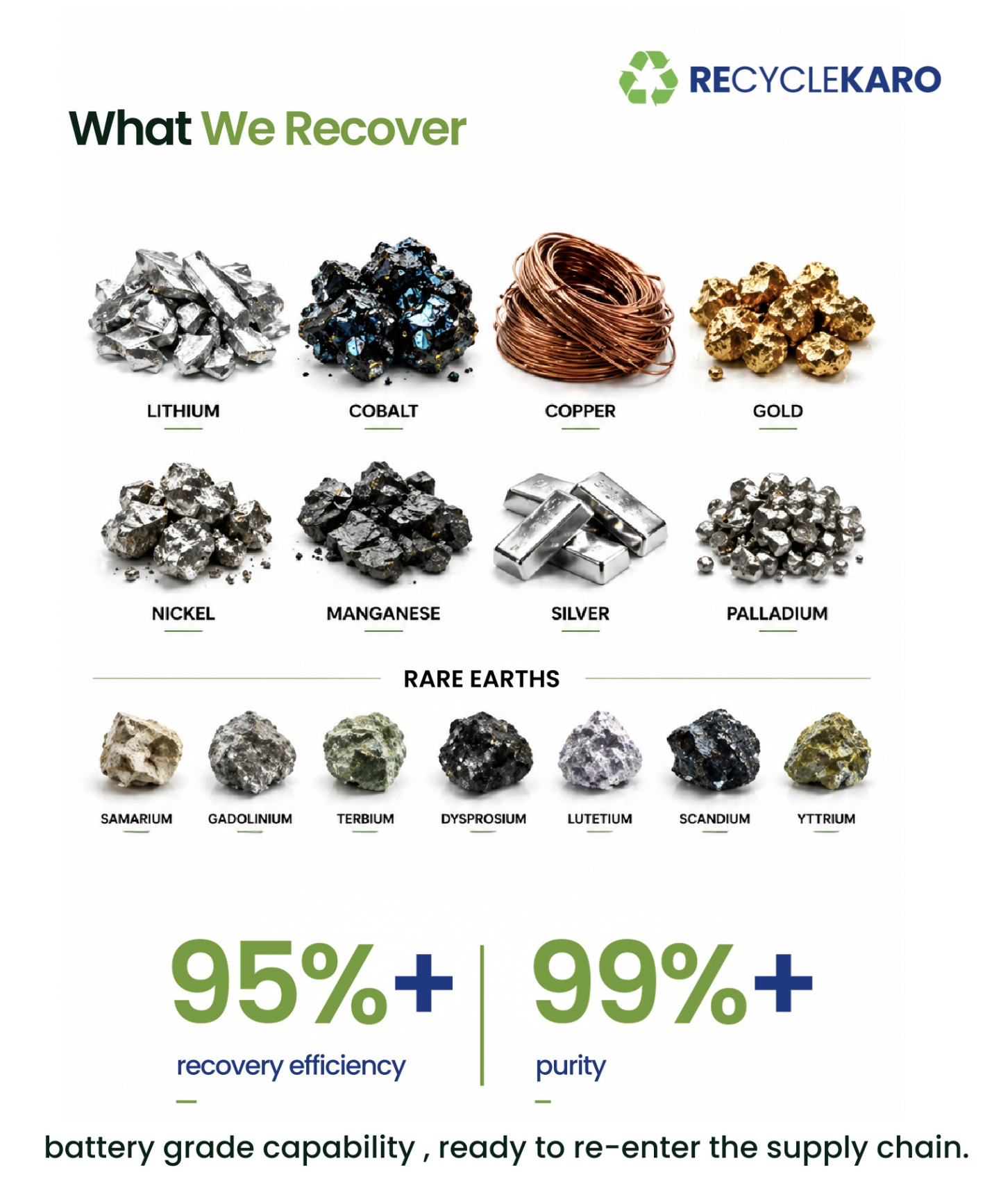
The economically important recoverables are lithium, cobalt, nickel and manganese from the cathode, graphite from the anode, plus the copper and aluminium in current collectors and casing. Cobalt and nickel carry the highest value, which is why recovery rates for those metals are the headline metric recyclers compete on.
How are EV batteries recycled, step by step?
The journey from a dead pack to reusable metal follows a consistent sequence, regardless of the recovery chemistry used at the end.
Collection, discharge and dismantling A qualified handler first removes the battery from the vehicle and records its manufacturer, chemistry, weight and physical condition, details that determine safe transport. The pack is then fully discharged to neutralise fire risk before technicians dismantle it into modules and cells. Safe handling is critical here: damaged lithium-ion cells can enter thermal runaway, so trained personnel and controlled environments are non-negotiable.
Shredding and producing “black mass” The modules are shredded in a controlled atmosphere. Magnets, sieves and centrifuges separate out the plastics, aluminium and copper, leaving a fine, dark powder known as black mass. This powder is the concentrate that contains the valuable cathode and anode materials- lithium, nickel, cobalt and graphite and it is the feedstock for the recovery stage.
Hydrometallurgical vs. pyrometallurgical recovery There are two dominant routes to pull metals out of black mass:
Hydrometallurgy dissolves the black mass in chemical solutions (leaching) and then selectively precipitates each metal. It runs at low temperature, recovers lithium as well as cobalt and nickel, and delivers very high purity which is why it dominates modern plants in India.
Pyrometallurgy smelts the material at 1,200–1,450°C to produce a metal alloy of cobalt, nickel and copper. It is simpler and tolerant of mixed feedstock but consumes more energy, typically loses the lithium and graphite, and requires off-gas treatment for the toxic emissions it generates. Many operators combine the two, smelting to concentrate, then hydrometallurgy to refine
Best-in-class hydrometallurgical processes recover around 95% of lithium and cobalt, and leading recyclers report recovering over 90% of critical materials overall. Those rates are what make recycling commercially viable and what India’s regulations increasingly demand.
What are India’s Battery Waste Management Rules 2022?
The Battery Waste Management Rules 2022 are the cornerstone regulation, covering all battery types – portable, automotive, industrial and EV. They establish a circular-economy framework built on Extended Producer Responsibility and enforce it through escalating, time-bound targets administered by the Central Pollution Control Board (CPCB).
What are the EV battery recovery and collection targets?
The Rules set two rising obligations. Material recovery – the share of a battery’s dry weight that must be recovered, climbs from 70% in 2024-25 to 90% by 2026-27.
Separately, collection targets require producers to ensure 70% of the EV batteries they placed on the market are collected by 2027-28, with the percentage rising in subsequent years. Batteries collected under the scheme cannot be landfilled or incinerated.
How does Extended Producer Responsibility (EPR) work?
Under EPR, the producer, not the consumer or the municipality, is legally accountable for what happens to a battery at end of life. Producers must register with the CPCB and meet their collection and recycling obligations. In practice they do this by buying EPR certificates from registered recyclers: each certificate represents a verified quantity of material recycled. This creates a market-based demand signal that channels spent batteries toward formal, compliant recyclers and away from the informal sector.
What are the recycled-content mandates?
To close the loop, the Rules require new batteries to contain a minimum share of domestically recycled material. That floor starts at 5% in 2027-28 and rises to 20% by 2030-31 effectively guaranteeing longterm demand for recovered metals and rewarding companies that invest in recovery capacity now.
How do producers stay compliant?
Compliance means registering on the CPCB portal, reporting quantities placed on the market, partnering with registered recyclers, and acquiring enough EPR certificates to cover the year’s targets.
For manufacturers and fleet operators, working with a single accountable recycling partner turns this into a clean, auditable workflow rather than a scramble.
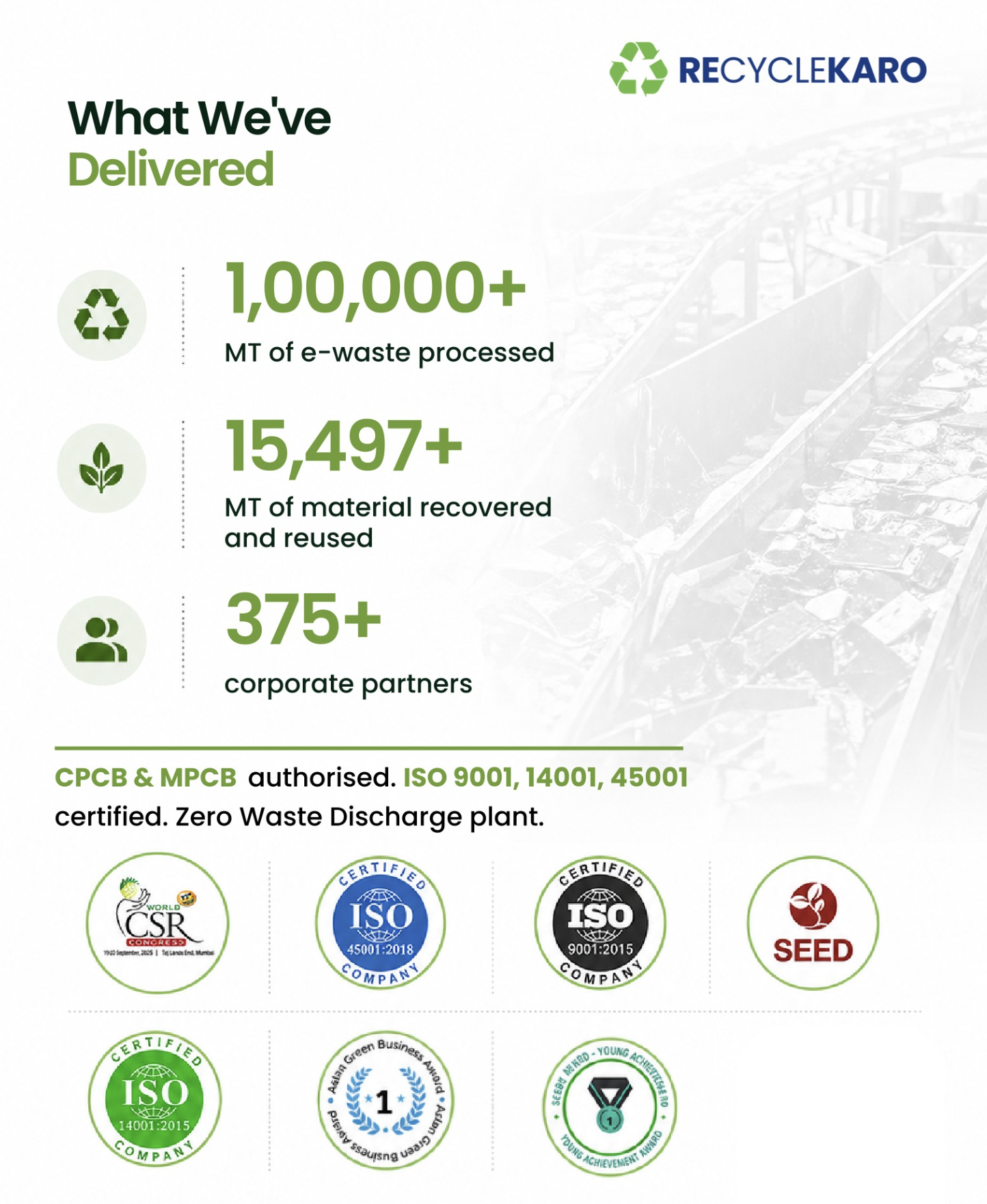
RecycleKaro is a CPCB-authorised recycler that helps battery manufacturers, automakers and fleet operators meet their EPR obligations end to end — from safe collection to verified recovery and documentation
Who is RecycleKaro, and how do we recycle EV batteries in India?
RecycleKaro is a Mumbai-headquartered e-waste and lithium-ion battery recycler, founded by Rajesh Gupta, and one of India’s leading players in the critical-mineral recovery space.
Our flagship 17-acre facility in Palghar, Maharashtra — supported by operations in Hyderabad and Noida, recovers lithium, cobalt, nickel and manganese from spent batteries and refines them into cathode-grade materials that flow back into the battery value chain.
Capacity: 10,000 tonnes per year of lithium-ion battery recycling (recently expanded from 4,200 tonnes) and around 24,000 tonnes of e-waste recycling.
Performance: over 95% metal recovery efficiency at 99.5% purity via a hydrometallurgical process.
Impact: recycling roughly 675 MWh and reusing 608 MWh of battery capacity each year, supporting India’s decarbonisation goals.
Trusted by: leading manufacturers and automakers including Bajaj Auto, Ather Energy, Hero MotoCorp and Tata Motors.
India’s recycling sector also includes players such as Attero, Lohum, Gravita and Exigo.
What sets RecycleKaro apart is the combination of high-purity cathode-grade output, an integrated e-waste and battery capability, full CPCB compliance, and a proven client roster across two- and four-wheeler OEMs so producers get both regulatory peace of mind and genuine circular-economy value.
How big is the EV battery recycling market in India?
Estimates vary by methodology, but every credible forecast points the same direction: steep growth. Research houses place the broader India battery recycling market anywhere from several hundred million to a few billion US dollars by the early 2030s, with the lithium-ion segment growing fastest, some analysts project 40%+ CAGR for lithium-ion recycling specifically.
How much recyclable battery volume is coming?
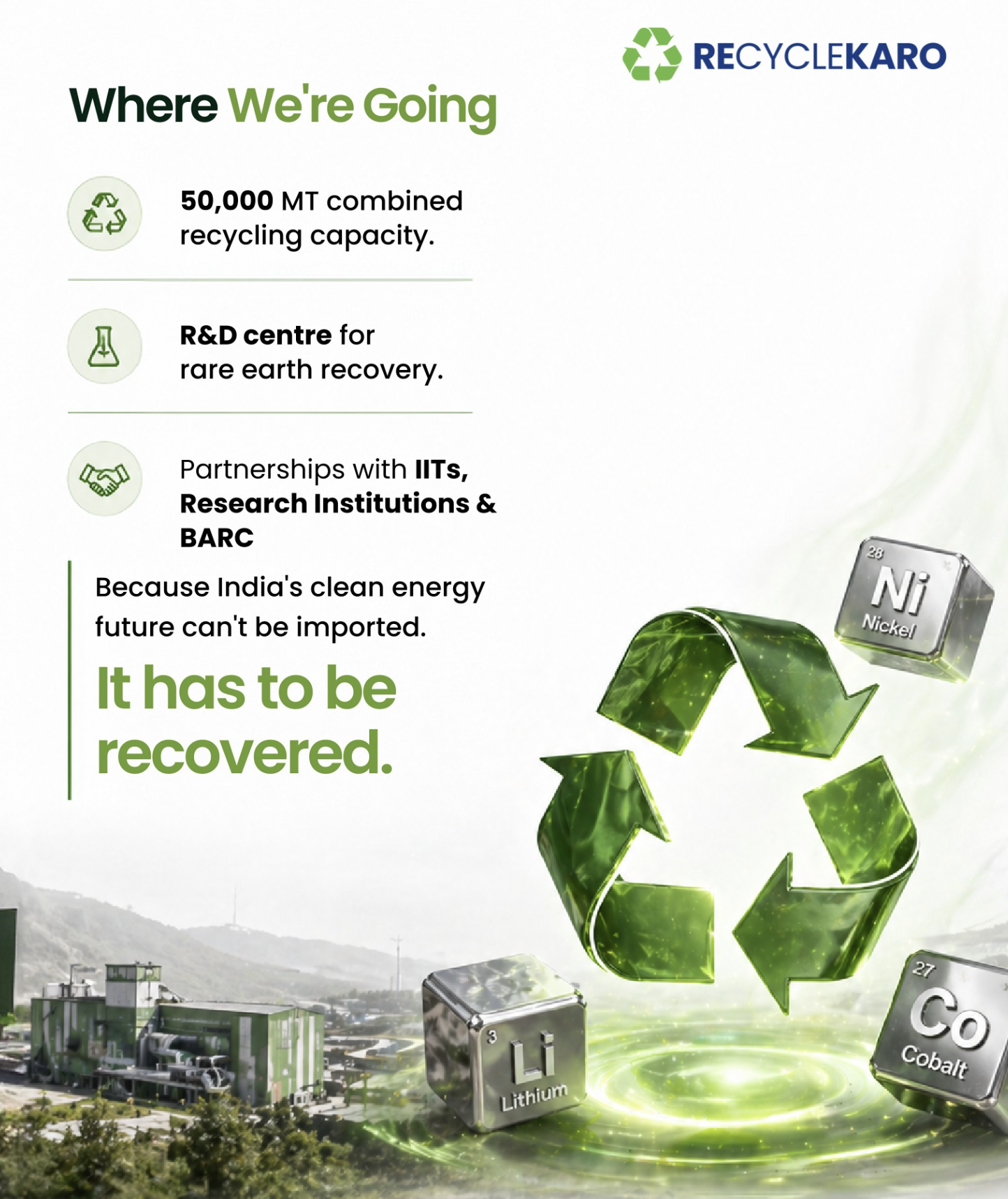
NITI Aayog projects around 128 GWh of recyclable batteries by 2030, of which EVs are expected to make up roughly 46%. That pipeline, combined with the recycled-content mandates, is why RecycleKaro is investing in capacity now, ahead of the surge in end-of-life EV batteries.
What is a second-life EV battery?
A second-life battery is a pack that no longer meets the demands of driving but still holds enough usable capacity for a less intensive job. Repurposing it postpones recycling, extends the value extracted from the original minerals, and adds a revenue stream between vehicle retirement and material recovery.
When does a battery move to second life instead of recycling?
The deciding metric is State of Health (SoH). Packs that retain roughly 70–80% of their original capacity are typically strong candidates for second-life use; below that threshold, recycling usually makes more sense.
Recyclekaro assesses and grades incoming packs so each one takes the highest-value path, reuse where viable, recovery where not.
Where are second-life batteries used?
Common destinations are stationary energy storage systems, backup power for telecom towers, and offgrid or renewable installations, applications where weight and peak performance matter less than cost per kWh of storage. In a country expanding both solar capacity and rural electrification, this is a meaningful and growing outlet.
EV battery recycling has shifted from a niche sustainability concern to a strategic pillar of India’s cleanmobility economy.
The Battery Waste Management Rules 2022 make it both mandatory and commercially attractive, and the volume of end-of-life batteries is set to surge through 2030.
RecycleKaro turns that challenge into value — recovering critical minerals at over 95% efficiency and 99.5% purity, keeping producers EPR-compliant, and strengthening India’s self-reliant battery supply chain.
Where can I recycle my EV or lithium-ion battery in India?
Through a CPCB-authorised recycler such as RecycleKaro, which safely collects end-of-life batteries and recovers their critical metals at Palghar, Hyderabad and Noida facilities.
2. Can EV batteries be fully recycled?
Not to 100%, but leading hydrometallurgical processes recover around 90–95% of the critical metals, RecycleKaro exceeds 95% efficiency at 99.5% purity, and India’s rules push recovery toward 90% of dry weight by 2026-27.
3. Is it legal to dispose of EV batteries in landfill in India?
No. Under the Battery Waste Management Rules 2022, collected batteries cannot be sent to landfill or incineration; they must go to registered recyclers.
The fine powder left after shredding a battery, containing lithium, nickel, cobalt and graphite — the concentrate that recovery processes refine into reusable, cathode-grade metals.
5. Who is responsible for recycling an EV battery?
Under EPR, the battery producer is legally responsible for ensuring collection and recycling, typically fulfilled by partnering with a registered recycler like RecycleKaro and acquiring EPR certificates.
Rahul Gogi
A growth strategist and sustainability advocate, Rahul works at the intersection of technology, circular economy, and green innovation. At Recyclekaro, he has played a key role in shaping strategic growth, stakeholder engagement, and industry conversations around critical minerals, clean energy transition, and advanced recycling technologies.
With a multidisciplinary background spanning electronics engineering, telecom, law, sustainability regulations, and digital growth, he brings a unique perspective on critical mineral recovery, rare earth extraction, and next-generation recycling ecosystems.