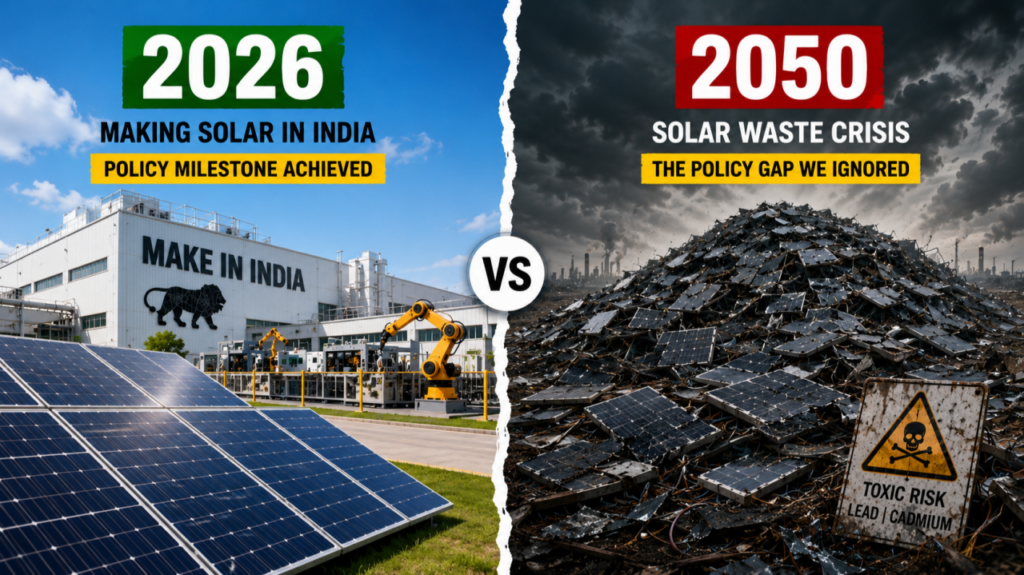
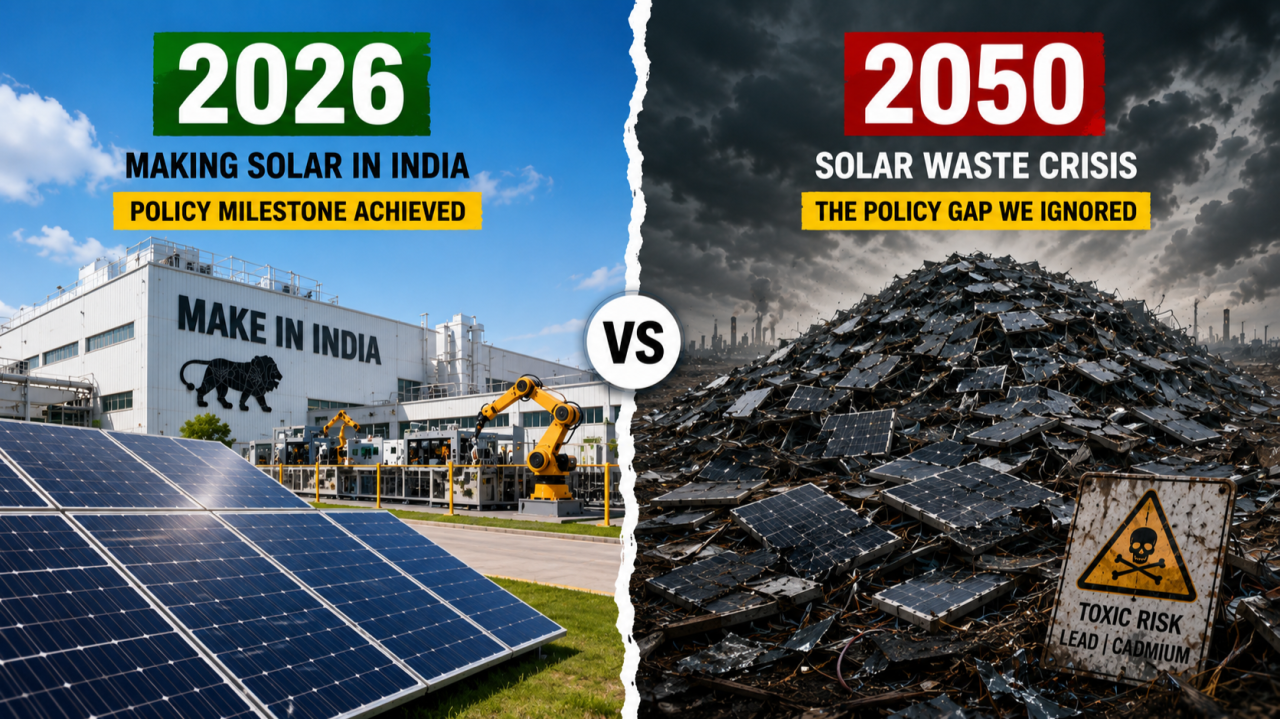
India just took a serious step toward energy independence. On June 1, 2026, the government’s ALMM List-II requirement came into force, mandating that solar modules used in government tenders be built from cells manufactured in India, not just assembled here from imported cells.
It’s a policy years in the making, and it closes a real gap. India has relied heavily on imported solar cells, even while assembling panels domestically, leaving its clean energy ambitions exposed to a single-country supply chain. The new domestic content requirement (DCR) pushes manufacturing further up the value chain, toward genuine self-sufficiency.
But there’s a second obligation buried inside every panel built under this mandate, one that doesn’t get nearly as much attention: every solar panel installed today will need to be disposed of, recycled, or dumped in roughly 25 years. India is scaling solar manufacturing at exactly the moment it has almost no infrastructure to handle solar waste at the other end of that lifecycle.
This article looks at why solar panel recycling in India deserves the same policy urgency as solar manufacturing and why the materials locked inside aging panels may matter more to India’s energy security than most people realize.
Why Solar Panel Recycling in India Matters Now
The DCR Mandate and What It Signals
The shift toward mandatory domestic cell manufacturing isn’t a minor compliance tweak — it’s a statement of industrial intent. India has the demand (one of the world’s largest renewable energy build-outs), the sunlight, and now a policy framework pushing investment into domestic cell production rather than just module assembly.
That’s the right call. A solar supply chain that depends on a single overseas source for its most critical component – the cell – isn’t a secure supply chain, no matter how much downstream assembly capacity exists domestically.
A 25-Year Obligation Just Got Bigger
Here’s the part that rarely makes it into the policy conversation: every gigawatt of solar capacity installed under the new mandate is also a future gigawatt of recycling obligation. Solar panels have a functional life of roughly 25 years. A panel commissioned this year will need to be decommissioned, recycled, or landfilled sometime around the early 2050s.
India’s generation-side policy is maturing quickly. Its end-of-life policy is not. That mismatch is the real story.
What’s Actually Inside a Solar Panel
To understand why this matters beyond environmental compliance, it helps to understand what a panel is physically made of.
A typical crystalline silicon (c-Si) solar panel, the dominant technology in India’s installed base, is built from:
– **Glass** (roughly 70% of panel weight, fully recyclable)
– **Aluminum frame** (highly recyclable, high scrap value)
– **Silicon wafers/cells** (the semiconductor layer that converts sunlight to electricity)
– **Silver paste** (used in extremely small quantities per panel for electrical conductors, but high cumulative value at scale)
– **Copper** (interconnects and wiring)
– **Polymer encapsulant and backsheet** (non-recoverable in most current processes)
– **Trace lead and cadmium** (present in some solder and thin-film variants — the main reason informal disposal is hazardous)
Thin-film technologies like CdTe use a different material stack but follow a similar recovery logic: most of the panel’s mass is glass and metal, with smaller but high-value quantities of semiconductor and conductive materials.
Both major panel technologies are technically capable of recovery rates in the 85–90% range using existing recycling processes. The technology to recover these materials is not the constraint. The economics and the infrastructure are.
The Solar Waste Numbers India Can’t Ignore
India’s solar build-out has been remarkable but scale on the generation side means scale on the waste side, on a predictable 25-year delay. Industry and policy analysts project India will become one of the largest generators of solar panel waste globally within the next few decades as its early-2010s and 2020s installations begin retiring. [CITE: verify against CEEW, IEA-PVPS, or MNRE waste projection data before publish]
The materials inside that future waste stream carry real recoverable value, credible estimates put the cumulative value of recoverable silicon, silver, copper, and aluminum from India’s retiring solar fleet in the thousands of crores over the coming decades. [CITE: verify specific recoverable-value estimate and attribute to named source, e.g., CEEW, before publish]
Against that trajectory, India currently has only a small number of dedicated solar panel recycling facilities, nowhere close to the capacity that the projected waste volume will require by the time the first major wave of installed-base panels reach end-of-life.
The infrastructure gap is not a future problem to plan for eventually. Given 25-year lifecycles, the panels that will need recycling capacity in the 2040s and 2050s are being installed right now which means the recycling infrastructure needs to be built in this decade, not the next one.
The Economics Problem: Why Landfill Still Wins
The 85–90% recovery rate sounds reassuring until you look at the economics. Recycling a solar panel today costs meaningfully more than simply disposing of it through informal or landfill channels. Without a financial mechanism, a producer responsibility fund, a recycling subsidy, a landfill disincentive – the cheaper, wrong option remains the economically rational one for most operators.
That’s not a hypothetical risk. It’s the same pattern India has already seen play out in other e-waste categories: when formal recycling costs more than informal disposal, informal disposal wins by default, and hazardous materials like lead and cadmium end up in soil and groundwater instead of back in the supply chain.
The Mining-vs-Recycling Energy Gap
There’s a deeper economic argument here that goes beyond disposal cost. Extracting silicon, silver, and copper from virgin ore is enormously energy-intensive mining, crushing, chemical leaching, and smelting all carry significant energy, carbon, and water costs. Recovering the same materials from end-of-life solar panels requires a fraction of that energy and happens entirely within India’s own borders, with no shipping, no import tariffs, and no exposure to global commodity price swings.
In other words: recycling isn’t just an environmental nice-to-have. It’s a cheaper, faster, more energy-efficient way to source the exact materials India’s growing solar cell manufacturing sector will need.
Solar Panel EPR in India: What’s Covered, What’s Missing
India’s E-Waste (Management) Rules, 2022 brought solar panels under formal Extended Producer Responsibility (EPR) obligations for the first time, a meaningful step forward on paper. [CITE: verify scope and effective provisions of E-Waste Rules 2022 as applied to solar panels before publish]
In practice, enforcement remains uneven. There is currently no dedicated, ring-fenced producer fund specifically for solar panel decommissioning unlike the EU’s WEEE framework, which mandates direct producer take-back and funding for end-of-life electronics including solar panels. Until that economic gap closes, EPR compliance on paper won’t translate into recycling behavior on the ground.
Critical Minerals Recovery: The Strategic Argument
This is the part of the conversation that deserves far more attention than it currently gets.
India’s domestic solar cell manufacturing ambition, the very ambition the DCR mandate exists to support, depends on a steady, affordable supply of silicon, silver, and copper. Today, much of that supply is sourced from virgin mining, much of it imported.
If India scales cell manufacturing without scaling materials recovery in parallel, it risks recreating the exact same vulnerability the DCR mandate was designed to solve, just one level down the supply chain. Every gram of silicon, silver, or copper sourced from imported virgin material instead of recovered domestic solar waste is a missed opportunity to build a closed-loop, domestically secured materials supply.
Scaling cell manufacturing without recycling the materials that go into those cells is like filling a bucket with a hole in it. The DCR mandate fills the bucket. Recycling infrastructure is what seals the hole.
This reframes solar panel recycling from a waste-management afterthought into a manufacturing self-sufficiency strategy, one that directly supports the same policy goals the DCR mandate is trying to achieve.
What Needs to Happen Next
Three structural changes would close most of the gap between India’s solar generation policy and its solar end-of-life policy:
- A solar-specific EPR fund. Manufacturers selling DCR-compliant panels into the Indian market should contribute to a decommissioning fund — tied to panel volume and technology type that subsidizes certified recycling at end-of-life, closing the cost gap that currently favors informal disposal.
- A national solar waste traceability database. Every DCR-compliant panel is now required to carry a unique traceability identifier for subsidy eligibility. [CITE: verify exact traceability certificate requirement and digit format against official ALMM documentation]
That data, manufacturer, technology type, installation date, location should feed into a central registry that lets recyclers and policymakers plan capacity ahead of actual waste volumes, rather than reacting to them. - Solar recycling named explicitly within critical minerals policy. Existing recycling incentive schemes tend to be written broadly across e-waste and battery scrap categories. Solar panel recycling and specifically silicon, silver, and copper recovery, deserves its own explicit targets within India’s critical minerals strategy, given how directly it supports domestic cell manufacturing goals.
How RecycleKaro Is Positioned for India’s Solar Recycling Future
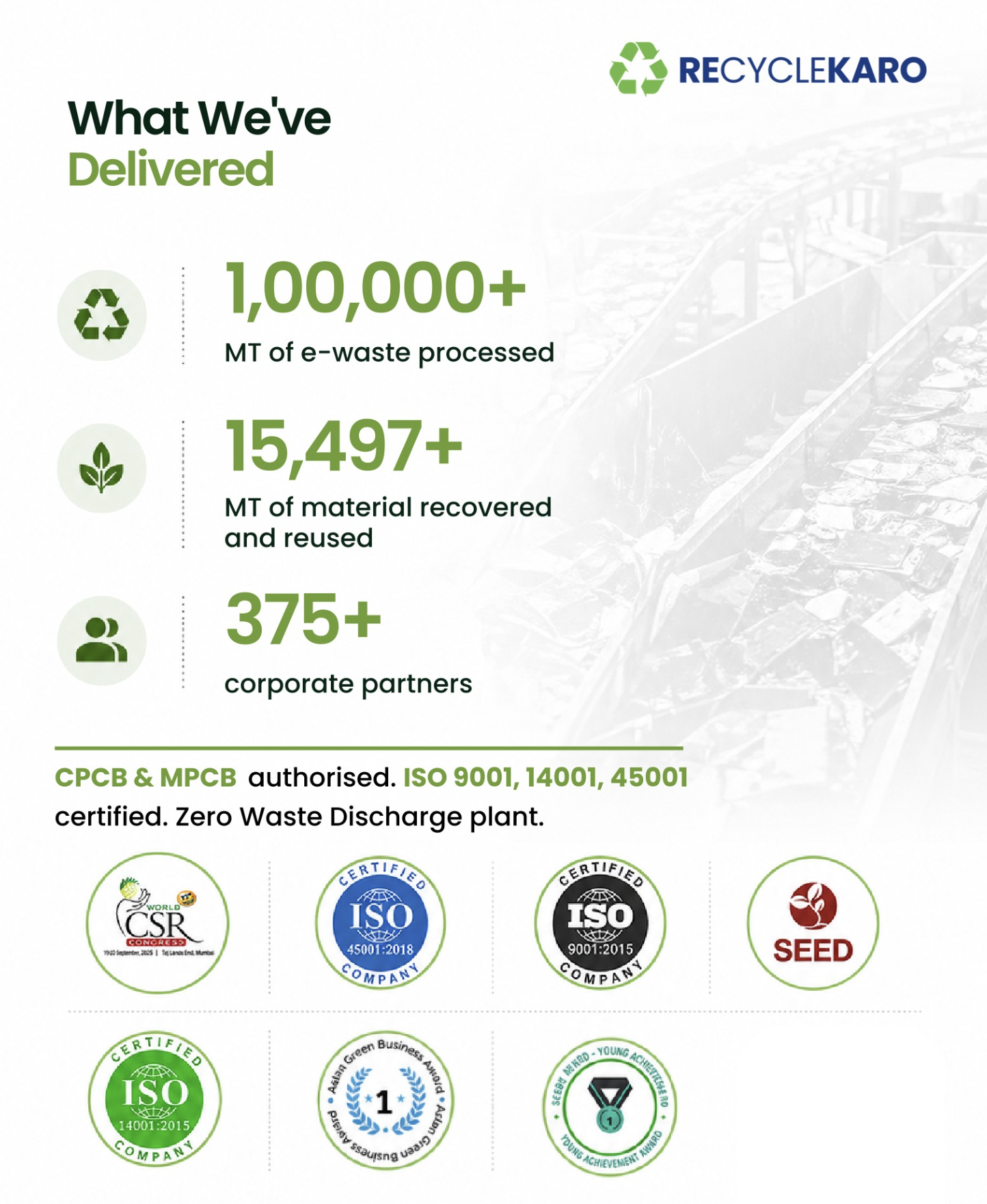
RecycleKaro already operates India’s largest lithium-ion battery recycling facility and one of the country’s largest e-waste recycling operations, built on more than 15 years of operating experience across a 17-acre, CPCB and MPCB-authorized facility.
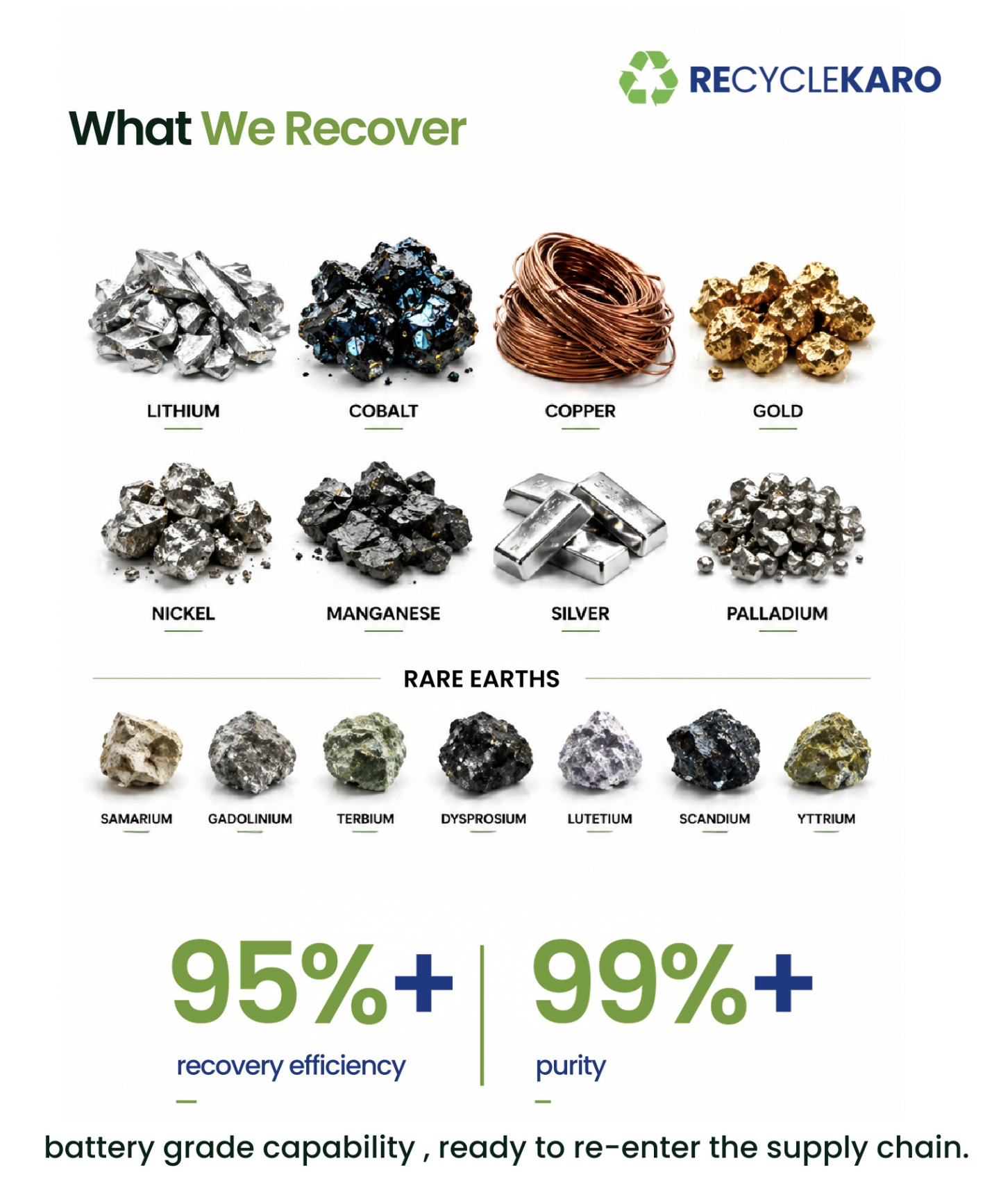
The capability that matters most for solar panel recycling isn’t new to RecycleKaro, it’s an extension of what the facility already does at scale. The same hydrometallurgical recovery processes used to extract battery-grade cobalt sulphate and nickel sulphate from lithium-ion batteries, at 95%+ recovery efficiency and 99%+ output purity, apply directly to recovering silicon, silver, copper, and aluminum from solar panel waste streams.
RecycleKaro’s certifications — ISO 9001, ISO 14001, ISO 45001, and R2v3 — along with active R&D partnerships with IITs and BARC focused on rare earth and critical mineral recovery, position the facility to extend its existing materials recovery infrastructure into solar panel waste as India’s installed base begins approaching end-of-life over the coming decade.
As India’s domestic solar cell manufacturing sector scales under the DCR mandate, the recyclers capable of feeding recovered silicon, silver, and copper back into that supply chain, with certified purity and verifiable, audit-ready sourcing, will become a structural part of the solar manufacturing ecosystem, not just a downstream waste vendor.