Critical minerals recycling is usually framed as a technology question: can lithium, nickel, and cobalt be recovered at high purity, and can that process scale from a lab bench to commercial volume? Those questions matter, but they answer only part of the problem.
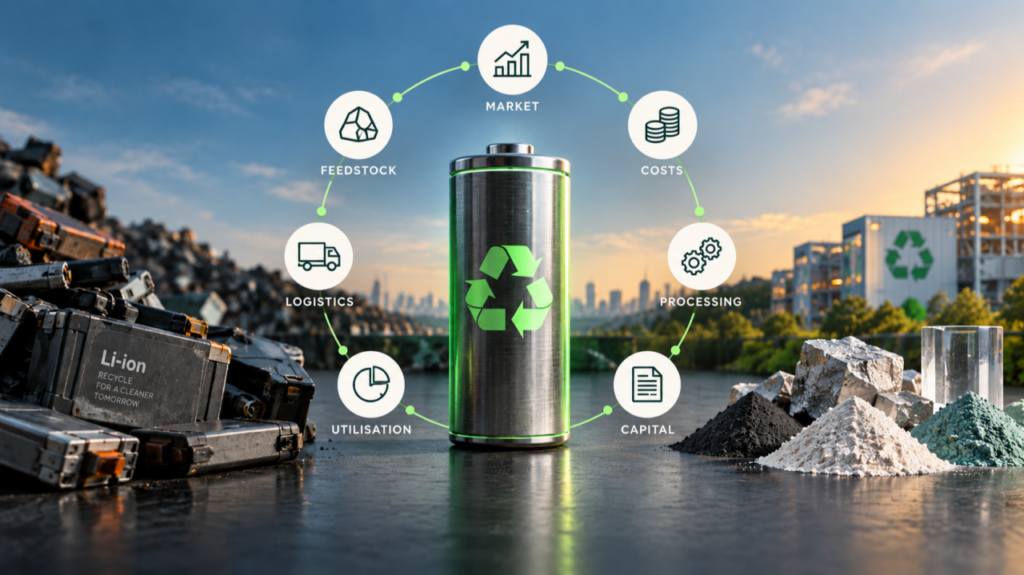
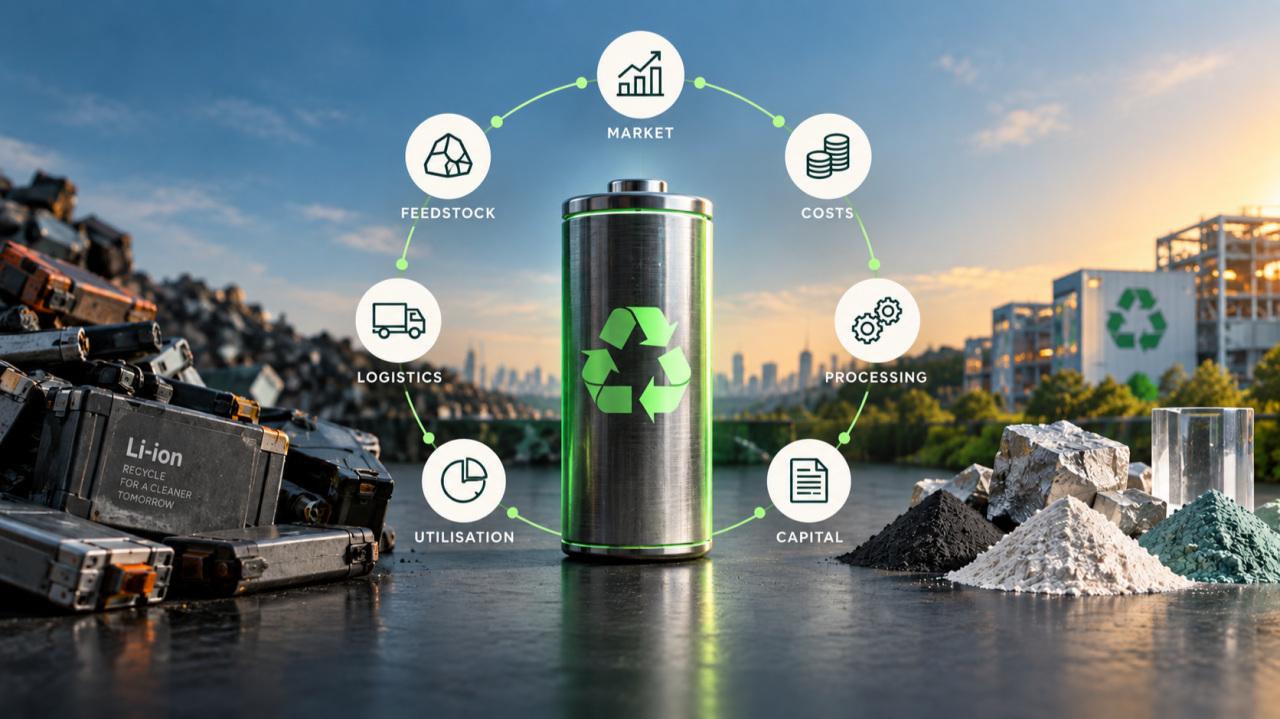
Critical minerals recycling economics are shaped just as much by feedstock quality, processing costs, capacity utilisation, commodity prices, logistics, and working capital as by the recovery chemistry itself. A plant can have sophisticated technology and still lose money if it can’t secure the right feedstock at the right cost, or if it can’t absorb a commodity downturn. The real question isn’t whether a recycler can recover a critical mineral, it’s whether that recovery holds up economically, consistently, under changing conditions.
What Is Critical Minerals Recycling and Why Does It Need an Economic Lens?
Critical minerals recycling is the recovery of high-value materials, primarily lithium, nickel, cobalt, copper, and rare earth elements from end-of-life batteries, electronics, and other hardware, for reuse in new products. It sits at the intersection of two pressures: a global scramble to secure supply of materials essential to EVs, grid storage, and clean energy, and a growing volume of end-of-life material that already contains those same minerals in concentrated, pre-processed form.
Framing this purely as a technical challenge – “can it be recovered?” misses the point that determines whether a recycling business survives. A recycler with excellent recovery chemistry and no reliable feedstock pipeline, or no ability to absorb a commodity price swing, is not commercially viable regardless of how clean its lab results look. Critical minerals recycling has to be evaluated as a system of interconnected commercial variables, not a single technical benchmark.
Critical minerals recycling refers to the recovery of essential materials like lithium, nickel, and cobalt from end-of-life products for reuse, aligning with global needs for sustainable supply chains.
Why Doesn’t Recovery Capability Guarantee Profitability?
Feedstock – The First Economic Variable
The first economic variable in recycling isn’t the process, it’s what enters the plant. Feedstock characteristics directly affect processing economics, because different battery chemistries carry very different quantities of recoverable value. The growing share of lithium iron phosphate (LFP) batteries in the market, for instance, has real implications for recycling economics: LFP contains none of the nickel and cobalt that make nickel-based chemistries economically attractive to process. The International Energy Agency (IEA) has specifically named battery chemistry and feedstock availability as key factors in the economic viability of battery recycling.
Feedstock characteristics determine the economic viability of recycling by influencing processing routes and the potential value that can be extracted from different battery chemistries.
This makes procurement more than a volume question. A recycler needs to understand the composition and value of what it’s acquiring because that composition determines which processing route makes sense and what value can realistically be generated. As the industry scales, securing sufficient and suitable feedstock becomes as central to the business as the recovery process itself.
Collection, Logistics, and the Delivered Cost of Material
Recycling economics don’t start at the plant gate. Material has to physically reach the facility, and the cost of collection, transport, handling, and pre-processing shapes the economics of the entire recycling route. Cost-model research into lithium-ion battery recycling has flagged transport, disassembly, logistics, and capital expenditure as cost elements that are frequently underweighted or inconsistently accounted for in economic assessments
The cost of logistics and transportation is a critical component in recycling economics, affecting the overall feasibility and profitability of the recycling process.
Geography compounds this. Research into the spatial distribution of recycling capacity has shown that mismatches between where batteries reach end-of-life and where recycling capacity is actually located can hurt both capacity utilisation and transportation economics. A recycling facility’s economics cannot be separated from the collection network that feeds it which is why feedstock sourcing infrastructure deserves the same strategic attention as the processing technology itself.
Is Nameplate Processing Capacity the Same as Economic Performance?
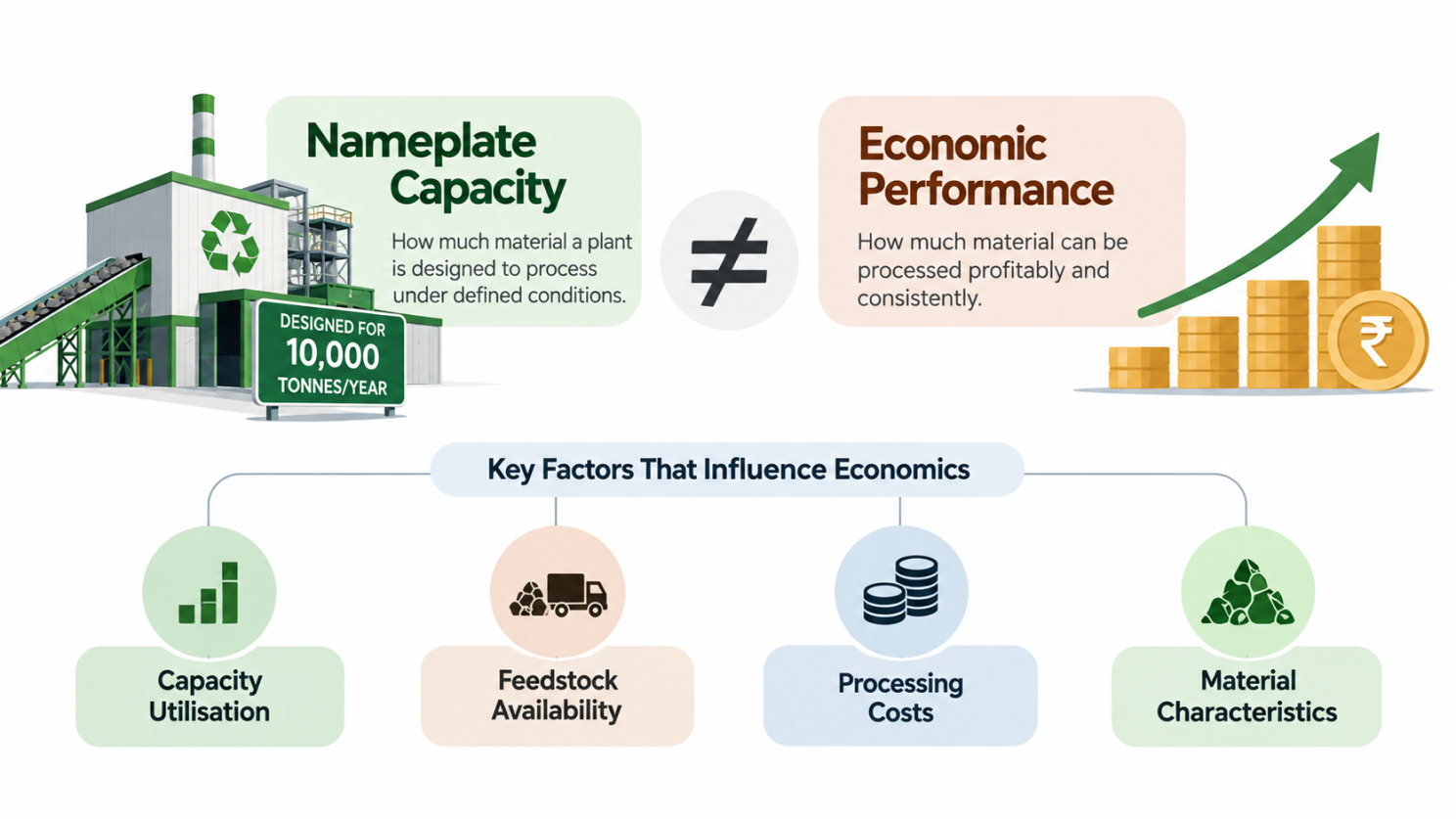
A plant’s stated processing capacity tells you how much material it’s designed to handle under defined conditions. It tells you nothing, by itself, about whether that processing is economically viable. Capacity utilisation, feedstock availability, processing costs, and material characteristics all determine the actual commercial outcome.
This distinction matters because recycling facilities carry significant capital and operating costs regardless of throughput. Cost-modelling research has found that recycling economics vary substantially by process route, feedstock, scale, and regional context, while techno-economic studies have identified material and energy prices as critical variables in feasibility. The commercial question isn’t how much a plant can process, it’s how much suitable material it can process economically and consistently, quarter after quarter.
Processing capacity does not equate to economic viability; it is the capability to process suitable material consistently that determines commercial success.
Is There One Universal Business Model for Recycling?
The diversity of battery chemistries and recycling routes makes a single universal economic model impossible to define. Pyrometallurgical, hydrometallurgical, and direct-recycling routes each carry different cost structures, different material outputs, and different process requirements and their economics shift again depending on feedstock and scale.
Pyrometallurgical vs. Hydrometallurgical vs. Direct Recycling – Different Cost Structures
-
Pyrometallurgical recycling uses high-temperature smelting to recover metals, typically at lower upfront process complexity but with higher energy costs and lower recovery of some elements (notably lithium).
-
Hydrometallurgical recycling uses chemical leaching to achieve higher-purity, higher-recovery outputs, but with more complex process control and reagent costs.
-
Direct recycling aims to recover and regenerate cathode material directly, potentially preserving more value but remains less commercially mature at scale.
Pyrometallurgical recycling employs high-temperature techniques for metal recovery, while hydrometallurgical recycling uses chemical processes to achieve higher purity and recovery rates.
Read full guide here: Direct Recycling vs Pyrometallurgy vs Hydrometallurgy
Why Process Optimisation Isn’t Just About Maximising Recovery
The instinct is to optimise for the highest possible recovery rate. But a commercially meaningful assessment weighs recovery against product quality, energy consumption, chemical consumption, throughput, and total processing cost together, not any single metric in isolation. Data-driven research has demonstrated how process simulation and multi-objective optimisation can be used to examine different operating conditions and balance recovery against product grade. The most technically impressive process is not automatically the most economically attractive one.
How Do Commodity Price Cycles Change Recycling Economics?
Recovered critical minerals are ultimately priced against commodity markets, and those markets move. Lithium, nickel, cobalt, and copper all experience meaningful price swings driven by supply, demand, inventory levels, and trade conditions. The IEA’s analysis shows how sharp these movements can be: battery material prices saw a substantial downturn through 2023 and 2024 before recovering through 2025 and into early 2026, with lithium prices more than doubling off their lows in that window.
Commodity price fluctuations significantly impact the economics of recycled materials, requiring recyclers to manage risks related to these market changes effectively.
For recyclers whose margins depend on the value of recovered material, these swings are not background noise, they’re a core operating risk. The IEA identifies battery-metal recycling as directly sensitive to material price fluctuations, and notes that recyclers need sufficient financial resilience and working capital to manage commodity cycles. This is exactly why alternative commercial structures — toll-based recycling and revenue-sharing arrangements — become relevant in volatile markets.
Toll-Based and Revenue-Sharing Models as a Price-Volatility Hedge
In a standard market-based model, the recycler buys feedstock and sells recovered material, absorbing full exposure to commodity price movement between those two points. Toll recycling shifts that structure: the recycler processes material on behalf of a customer for a service fee, largely stepping out of commodity-price exposure. Revenue-sharing models sit between the two, splitting exposure between recycler and feedstock owner. Neither model is inherently superior — the right choice depends on how much price volatility a given business can absorb, and how confident it is in its feedstock pipeline.
How Does Battery Chemistry Change the Business Model?
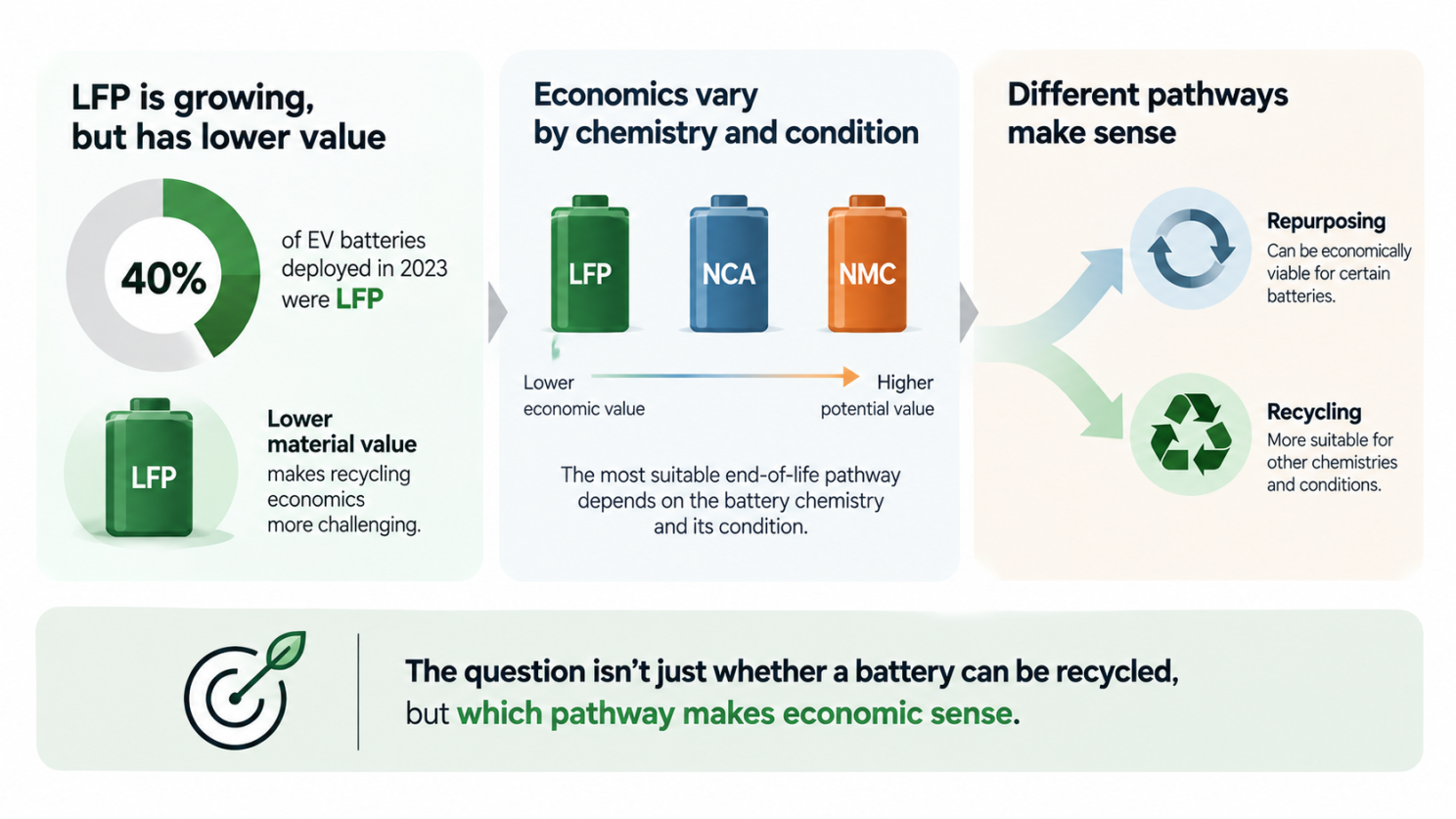
Battery chemistry isn’t only a technical input — it shapes the underlying business model available to a recycler. The IEA estimates LFP batteries represented around 40% of EV batteries deployed in 2023, and notes that their lower material value creates real challenges for conventional, market-based recycling economics [CITE: verify current IEA figure]. The agency has pointed to toll-based models and regulatory support as mechanisms that can improve the economics of recycling lower-value chemistries.
Why LFP Batteries Challenge Conventional Recycling Economics
Because LFP batteries contain no nickel or cobalt, the recovered-material value per tonne is meaningfully lower than NMC or NCA feedstock — even though the processing cost isn’t necessarily lower. This is precisely the gap that toll-based and service-fee models are designed to close: the recycler is compensated for processing capability and compliance value, not solely for the commodity value of what’s recovered.
LFP batteries have lower economic value in recycling due to the absence of nickel and cobalt, which challenges traditional market-based recycling models.
Repurposing vs. Recycling: Which Pathway Makes Economic Sense?
Chemistry and first-life battery condition also determine which end-of-life pathway makes the most economic sense. A 2026 study found that the economics of repurposing versus recycling varied meaningfully across LFP, NCA, and NMC batteries, depending on chemistry and how much capacity the battery retained at end of first life.
The question is shifting from “can this battery be recycled?” to “which recovery or reuse pathway is economically optimal for this specific feedstock, under current market and technical conditions?” – a much more differentiated, and more commercially demanding, question.
Why Is Data Becoming a Competitive Capability in Recycling?
A recycling business has to track feedstock composition, processing conditions, material recovery, product quality, energy and chemical consumption, inventory, and commodity exposure and understand how a change in any one of those affects the economics of the rest.
Research has already demonstrated the value of this approach at scale: one study built more than 10,000 process simulations to examine how operating parameters affect recovery and product grade, then used that dataset for multi-objective optimisation. Not every recycler needs identical digital infrastructure, but the direction is clear – moving optimisation decisions away from intuition and toward data connects procurement, production, and commercial decision-making into a single feedback loop.
Data analytics play a crucial role in enhancing the operational efficiency of recycling businesses by allowing for informed decision-making regarding process optimisations.
Why Working Capital Is as Important as the Technology Stack
Recycling is a working-capital business as much as a technical one. Feedstock often has to be purchased before recovered material is sold. Inventory sits inside the processing cycle for weeks at a time. Customers buy recovered products on defined payment terms. Meanwhile, operating and capital costs continue regardless of where prices sit that quarter.
The IEA specifically identifies balance-sheet strength and working capital as critical considerations for market-based battery recycling, given exposure to price fluctuations and commodity cycles. This matters most acutely when a recycler is buying feedstock and selling recovered material while prices are moving in opposite directions within the same cycle. Financial resilience and operational resilience are, in practice, the same thing – a technically sound process still needs a commercial structure capable of financing its material flows through volatility.
Working capital is essential for recycling operations, ensuring that financial obligations are met despite fluctuations in commodity prices and market conditions.
What Does This Mean for India’s Critical Minerals Strategy?
India’s push toward domestic critical minerals security spanning lithium, cobalt, and rare earth supply for EVs, grid storage, and electronics manufacturing cannot rely on primary extraction alone. Domestic recycling capacity is a direct, faster-to-build lever for reducing import dependency, but only if that capacity is built with the commercial resilience this article describes, not simply processing capacity on paper.
This is the operating principle behind RecycleKaro’s approach at its Palghar, Maharashtra facility: recovery infrastructure has to be paired with feedstock strategy, commodity-risk management, and working-capital discipline to actually contribute to India’s mineral security goals, rather than existing as unused nameplate capacity.
The RecycleKaro Approach – Connecting Technical and Commercial Intelligence
RecycleKaro operates a 17-acre facility in Palghar, Maharashtra, with over 95% material recovery efficiency and 99%+ output purity, R2v3 and ISO 9001/14001/45001 certification, and CPCB and MPCB authorisation under the Battery Waste Management Rules, 2022. But the proof points that matter to a commercial evaluation go beyond certification: 375+ corporate partners including Bajaj Auto, Tata Motors, Hero MotoCorp, and Ather Energy, and standing as India’s largest recycled cobalt manufacturer — evidence of sustained, economically viable operation at scale, not just technical capability.
Talk to a compliance partner you can prove
RecycleKaro helps producers, importers, and brand owners register, hit their targets, and meet them with EPR certificates backed by genuine, audit-ready recycling. If you want your obligations checked and a clear plan to stay compliant –