Lithium-ion batteries are recycled using three main methods: pyrometallurgy (smelting at temperatures above 1,400°C), hydrometallurgy (acid leaching of shredded battery material known as black mass), and direct recycling, a newer process that restores the cathode’s crystal structure through a technique called relithiation instead of destroying it.
Pyrometallurgy loses most of the lithium and consumes significant energy. Hydrometallurgy recovers more lithium but relies on hazardous chemicals. Direct recycling avoids both drawbacks, recovering cathode active material at recovery rates of 95–99% and at a lower cost per kilogram.
For India, which imports nearly all of its battery-grade lithium and cobalt, the method chosen for recycling has a direct bearing on supply-chain resilience.
What happens to a Lithium-Ion Battery at the End of Its Life?
When a lithium-ion battery reaches end of life, the industry has relied on two dominant pathways to recover value from it: pyrometallurgy and hydrometallurgy. Both work, and both are used at commercial scale today.
Both are also wasteful compared to what is now possible, because both take a precision-engineered material and reduce it to raw ingredients before rebuilding it from scratch- an extra, energy-intensive step that a third method skips entirely.
What Is Pyrometallurgy (Smelting) in Battery Recycling?
Pyrometallurgy sends the battery into a furnace at temperatures above 1,400°C. Everything burns. Metals such as cobalt and nickel survive the process and can be recovered, but lithium is largely lost, and the smelting step consumes enormous amounts of energy while producing significant emissions. What comes out is raw metal, which still needs another full round of processing before it can go into a new battery.
What Is Hydrometallurgy (Acid Leaching) in Battery Recycling?
Hydrometallurgy shreds the battery into what is called black mass, then dissolves it in acid. Chemical processes separate the individual metals out of the resulting solution.
Lithium recovery is better here than with smelting, and output purity is higher, but the process still requires hazardous chemicals, produces acid wastewater, and destroys the cathode structure entirely in the process of extracting the metals from it.
What Is Direct Recycling and How Is It Different?
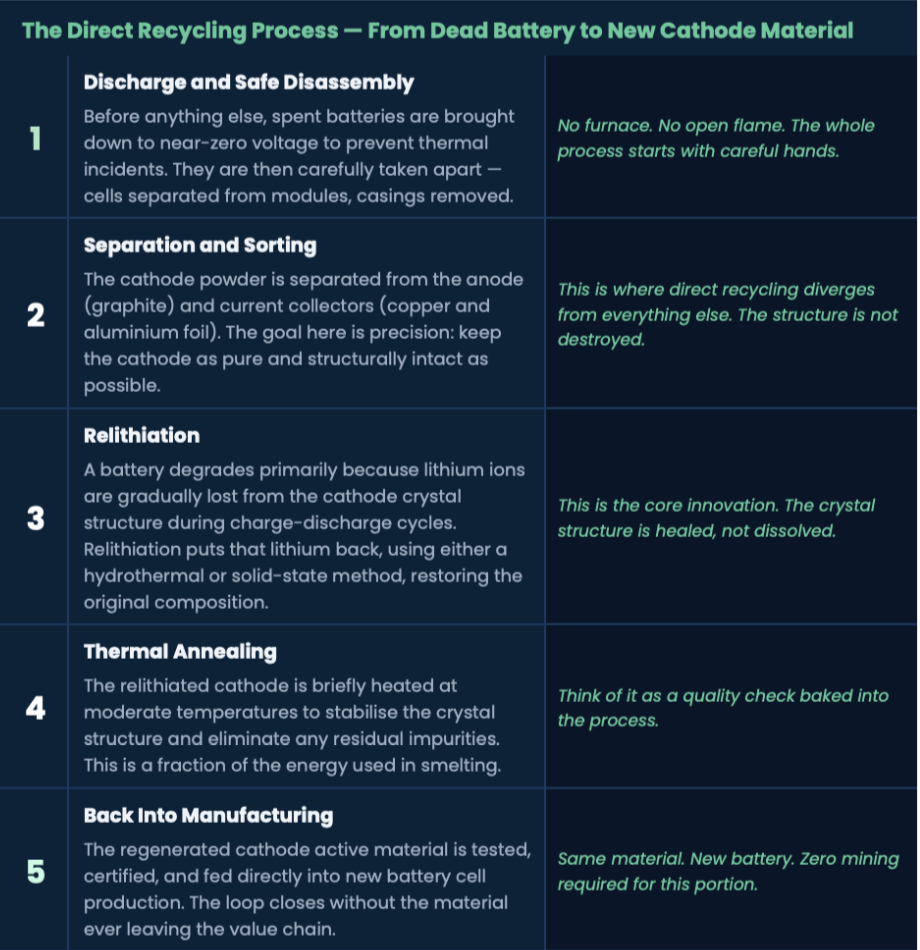
Direct recycling takes a fundamentally different approach. Instead of destroying the cathode to extract the metals inside it, it recovers the cathode active material itself, refreshes it, and puts it back into service, skipping the furnace and the acid bath entirely.
What Is Relithiation?
When a battery degrades over time, the main cause is that lithium ions are gradually lost from the cathode’s crystal structure during repeated charge-discharge cycles. The structure itself usually stays largely intact, what it needs is lithium put back in. That process is called relithiation, and it can be carried out using hydrothermal or solid-state methods under relatively mild conditions, without a furnace or an acid bath.
Why Does the Cathode Crystal Structure Matter?
Cathode active material is not just a mix of metals. It is a precision-engineered crystal structure, built at the atomic level to hold and release lithium ions in a specific, repeatable way and that structure is what makes the battery work in the first place.
Melting it or dissolving it destroys the engineering that went into building it. Direct recycling is the only one of the three methods that keeps that engineering intact, which is why its recovery rates and output quality are consistently higher.
Direct Recycling vs Pyrometallurgy vs Hydrometallurgy: How Do the Three Methods Compare?
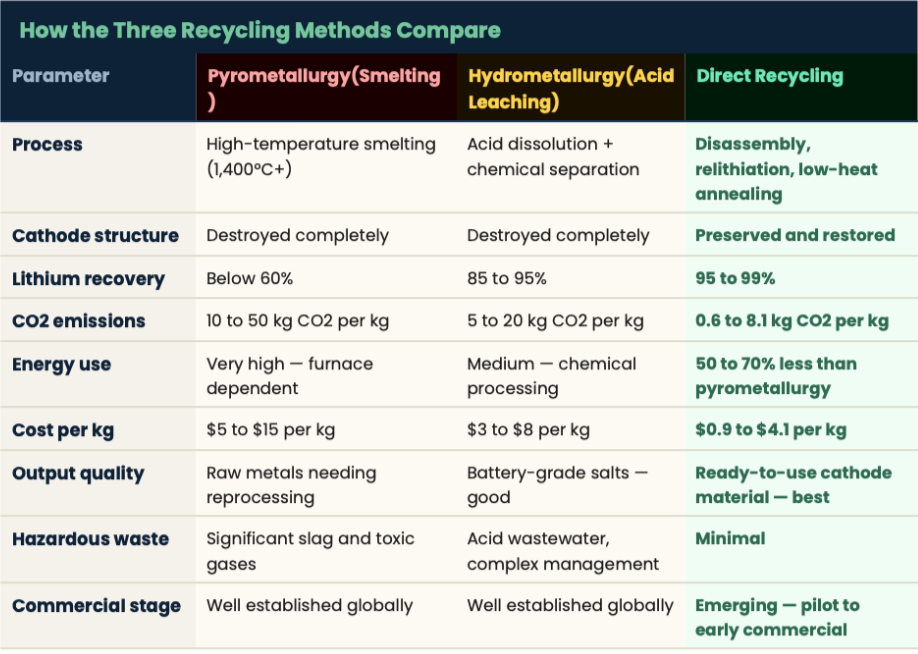
Lined up side by side, the differences between the three methods are stark, not just in what they recover, but in what they cost and what they leave behind.
|
Factor |
Pyrometallurgy |
Hydrometallurgy |
Direct Recycling |
|---|---|---|---|
|
Process |
Smelting at 1,400°C+ |
Acid leaching of black mass |
Relithiation of intact cathode structure |
|
Lithium recovery |
Largely lost |
Recovered, moderate purity |
95–99% |
|
Output |
Raw metal, needs further processing |
Individual metal salts |
Finished cathode active material |
|
Energy use / emissions |
Very high |
Moderate; hazardous wastewater |
Significantly lower |
|
Cost per kg processed |
Highest |
$0.9–$4.1/kg (comparable range) |
$0.9–$4.1/kg, often at or below hydrometallurgy |
The pattern across every column is the same: direct recycling recovers more, costs less, and produces a higher-value output than either of the two incumbent methods provided the feedstock and scale challenges covered later in this article are addressed.
Is Direct Recycling Cheaper Than Hydrometallurgy and Pyrometallurgy?
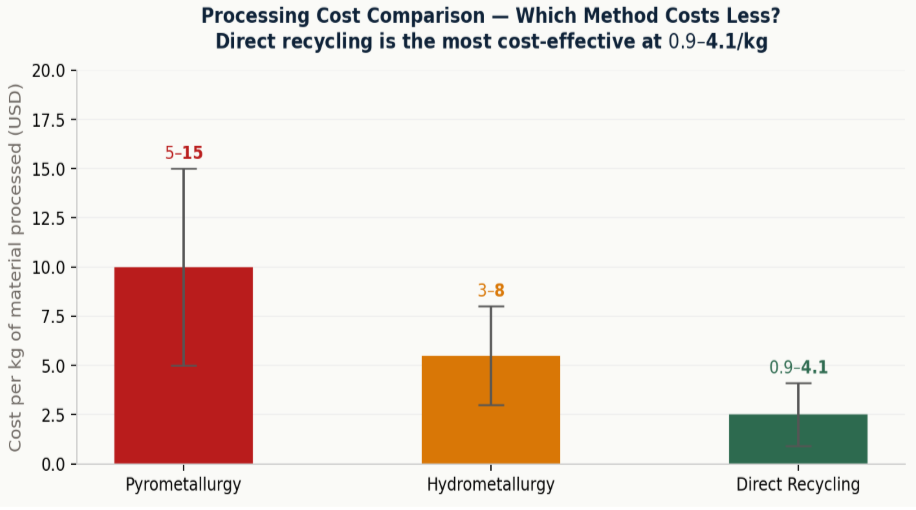
On a pure cost-per-kilogram basis, direct recycling is already competitive with hydrometallurgy in many scenarios and well below smelting, at an estimated $0.9 to $4.1 per kilogram of material processed. As the technology matures and scales, those numbers are expected to improve further.
There is a second, less obvious economic argument that matters just as much. Traditional recycling gives you metals. Direct recycling gives you finished cathode active material. Turning recovered metals into cathode active material requires additional processing steps, energy, and reagents, when direct recycling skips that entire step and delivers the finished material directly, the cost savings compound rather than simply add up.
Why Does India Need Direct Recycling for Its Battery Supply Chain?
India imports nearly 100% of its lithium-ion battery cells, primarily from China. Almost all of the critical minerals that go into those cells- lithium, cobalt, and nickel among them are imported as well. For a country building a domestic electric vehicle industry and targeting 500 GW of clean energy capacity by 2030, that is not a sustainable starting position.
How Much Lithium and Cobalt Does India Currently Import?
The concentration of India’s lithium and cobalt supply in a small number of source countries is a recognized structural risk. Every kilogram of cathode material recovered domestically through direct recycling is a kilogram that does not need to be mined, refined, and shipped in from elsewhere which is precisely the kind of supply-chain resilience India’s EV and clean energy targets depend on.
What Happens to India’s Black Mass Exports Today?
In the year following October 2022, India exported black mass containing approximately 350 tonnes of cobalt, 71.7 tonnes of lithium, and 215 tonnes of nickel. These are materials the country had to import in the first place, sent back out as low-value scrap, often to be processed abroad and sold back to Indian manufacturers at a premium.
Closing that loop domestically, through facilities built for direct recycling and supported by R&D partnerships with institutions like IIT and BARC, is where the real economic opportunity sits.
What are the Limitations of Direct Recycling?
Direct recycling is promising, but it has real limitations that are worth stating plainly rather than glossing over.
Can Direct Recycling Handle Mixed Battery Chemistries (NMC vs LFP)?
The technology works best on a consistent chemistry. NMC cathodes respond differently to relithiation than LFP cathodes, and mixing the two without careful sorting beforehand reduces both efficiency and output quality.
India’s current battery collection infrastructure does not sort reliably- batteries from two-wheelers, laptops, power tools, and grid storage systems often end up in the same stream, and separating them adds cost and complexity.
Is Direct Recycling Ready for Commercial-Scale Operations?
Most of the strongest recovery numbers reported for direct recycling come from lab-scale or pilot-scale operations. Moving from a controlled research environment to a facility processing thousands of tonnes a year introduces its own engineering problems: equipment has to handle contaminated, degraded, and physically damaged cells, and the relithiation step needs to stay precise at scale, which is harder in practice than it sounds.
Several global players, including university-affiliated research centers and specialty recyclers, are actively working through these engineering constraints, but the technology has not yet been fully solved at commercial volumes anywhere in the world. That gap between lab performance and plant-floor reliability is exactly where sustained R&D investment makes the difference.
How Does Feedstock Consistency Affect Direct Recycling Economics?
Direct recycling’s economics depend on a steady, predictable supply of end-of-life batteries. In India, the formal collection system is still early-stage, most batteries that reach end of life disappear into informal channels, get dismantled without any tracking, or simply sit unused in drawers and garages for years. Without reliable feedstock, a direct recycling facility cannot run at the utilization rate its economics require.
How RecycleKaro Is Building India’s Urban Mine
Recovery efficiency and purity benchmarks
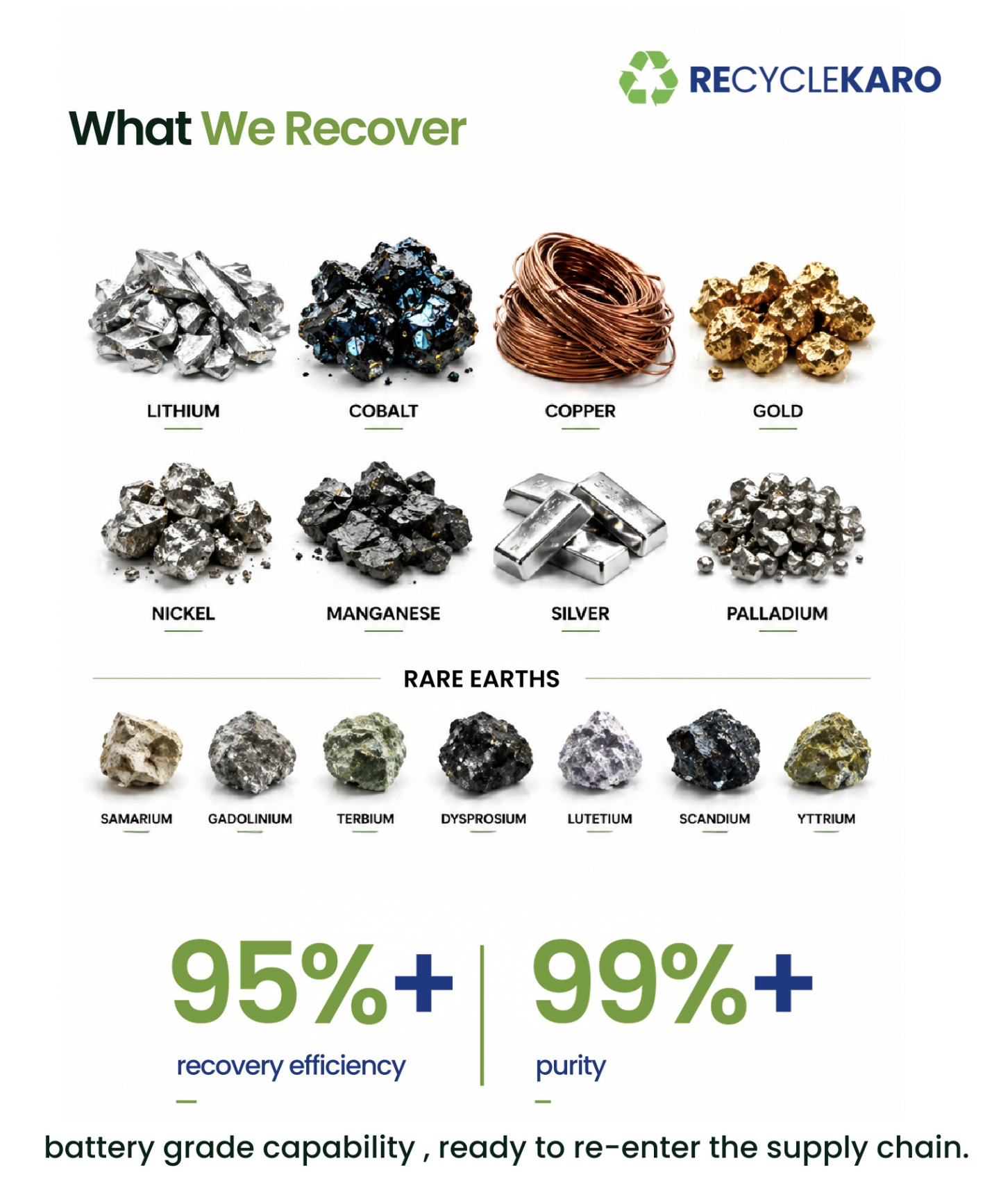
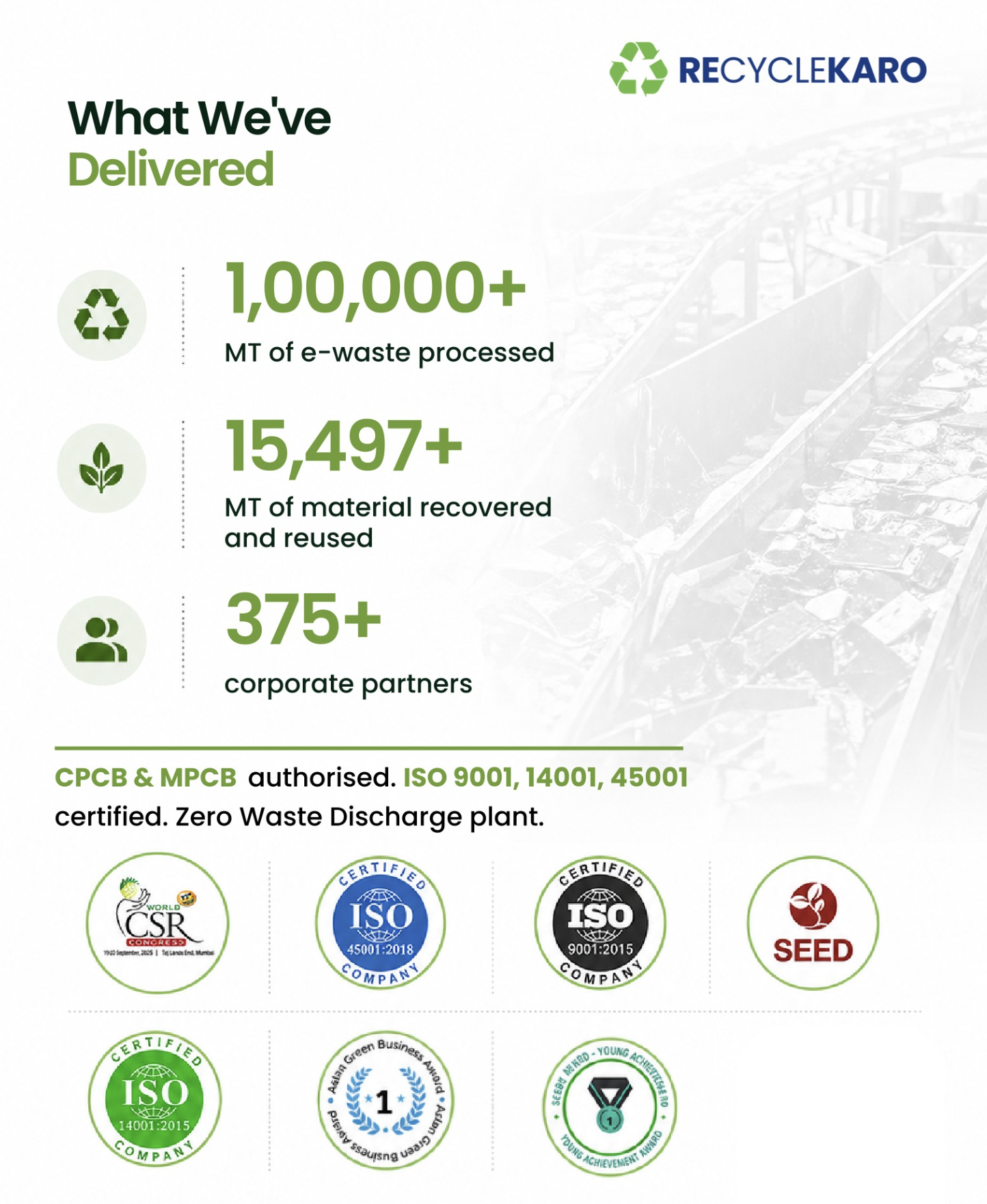
RecycleKaro operates a CPCB- and MPCB-authorized, R2v3 and ISO 9001/14001/45001-certified recycling facility in Palghar, Maharashtra, recovering lithium, cobalt, nickel, copper, gold, silver, palladium, manganese, and seven rare earth elements at 95%+ recovery efficiency and 99%+ purity, output that meets battery-grade specifications and is ready to re-enter the supply chain.
R&D partnerships and scale-up plans
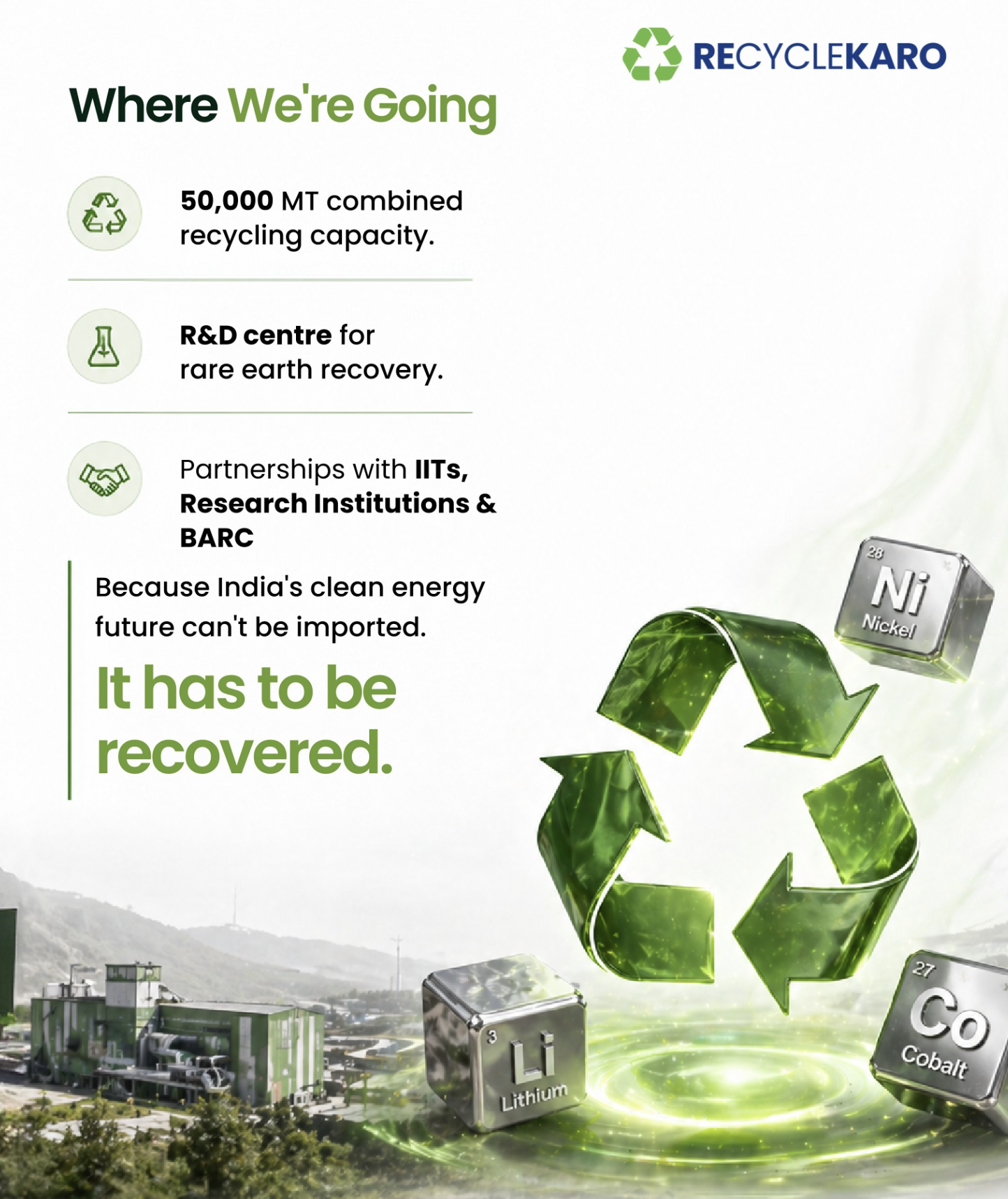
Backed by 15+ years of operating history, a 17-acre facility, 300+ employees, 12,000+ collection touchpoints, and 375+ corporate partners feeding material into the recovery pipeline, RecycleKaro is also building forward: R&D partnerships with IIT and BARC on rare earth recovery, and a stated target of 50,000 MT of combined recycling capacity as India’s battery and e-waste volumes scale.