Rare earth recovery is the process of extracting valuable elements: neodymium, dysprosium, praseodymium, and others from discarded electronics, EV motors, and permanent magnets instead of mining them from virgin ore.
India imports nearly all the rare earth elements it uses, making recovery from e-waste a faster, lower-risk alternative to developing new mines. The process runs through mechanical dismantling, magnetic separation, and then hydrometallurgical or pyrometallurgical extraction to isolate usable rare earth oxides.
With China’s export restrictions exposing India’s supply risk, recovery is now central to national policy, from the PLI scheme to BARC-developed extraction technology.
What Is Rare Earth Recovery?
Rare earth recovery is the set of industrial processes used to extract rare earth elements from products that have reached the end of their working life like permanent magnets, hard disk drives, EV motors, wind turbine generators, and fluorescent lighting so those elements can be refined and reused in new manufacturing.
It sits within the broader field of e-waste recycling and critical minerals recovery, but it targets a narrower, higher-value group of materials that most conventional recycling streams don’t isolate.
What are rare earth elements, and why do they matter?
Rare earth elements (REEs) are a group of 17 metallic elements including neodymium, dysprosium, praseodymium, terbium, samarium, yttrium, lanthanum, and cerium, prized for their magnetic, luminescent, and catalytic properties.
Despite the name, most are not geologically rare; what’s scarce is the concentration in which they’re economically mineable, and the refining capacity to process them into usable form.
Neodymium and dysprosium in particular are used to make NdFeB magnets, the strongest commercially available permanent magnets, which power EV traction motors, wind turbine generators, hard disk drives, and precision electronics.
Read More: Why should Neodymium Magnets be recycled?
How is rare earth recovery different from rare earth mining?
Mining extracts rare earths from ore bodies in the ground, a capital-intensive process that typically takes a decade or more to move from exploration to production, and one that carries significant environmental and radiological waste-handling burdens because rare earth ores often occur alongside thorium and uranium.
Recovery, by contrast, extracts the same elements from products that already exist and have already been refined once. It requires no new mine, no new ore body, and a fraction of the lead time which is exactly why “urban mining” has become the phrase of choice in Indian policy circles over the past year.
Read More: Urban Mining: How India can recover the critical minerals it currently imports?
How Are Rare Earth Elements Recovered From E-Waste?
What sources of e-waste contain recoverable rare earths?
The highest-value feedstock is NdFeB permanent magnets, found in hard disk drives, speaker systems, EV and e-bike motors, wind turbine generators, and MRI machines.
Nickel-metal-hydride batteries (common in older hybrid vehicles) and fluorescent lamp phosphors are secondary sources.
As India’s EV and electronics base matures and its first generation of hybrid and electric vehicles reaches end-of-life, motor magnets are expected to become an increasingly significant feedstock category.
What is the mechanical pre-processing stage?
Recovery begins with manual and mechanical dismantling: devices are stripped down to isolate magnet-bearing components, which are then shredded or crushed.
Magnetic separation follows, using the magnets’ own field strength to sort them out of the broader mixed-metal stream before any chemical processing begins. This stage is labor- and equipment-intensive, and it’s also where informal-sector recyclers in India currently do the most damage, magnets pulled apart carelessly lose value, and materials that aren’t properly sorted end up landfilled or exported as low-grade scrap rather than recovered domestically.
What is hydrometallurgical recovery, and how does selective leaching work?
Hydrometallurgical recovery dissolves shredded magnet material in acid, then uses selective leaching and solvent extraction to separate individual rare earth elements from the resulting solution based on their differing chemical affinities. This is the dominant recovery method globally because it achieves high purity and is more energy-efficient than heat-based alternatives, though it generates acidic wastewater that requires careful treatment, a compliance point tightly linked to CPCB and Zero Waste Discharge requirements.
What is pyrometallurgical recovery, and when is it used instead?
Pyrometallurgical recovery uses high-temperature smelting to separate materials, and is generally favored when feedstock is heavily mixed or contaminated in ways that make direct chemical leaching inefficient.
It is faster at scale but more energy-intensive and less precise at isolating individual elements, so most modern facilities use it as a pre-treatment step ahead of hydrometallurgical refining rather than as a standalone recovery method.
BARC’s research into plasma furnace technology for rare earth extraction falls into this category.
Why Is Rare Earth Recovery Urgent for India Right Now?
How dependent is India on imported rare earth elements?
India has known rare earth reserves, largely as monazite sands along its coastline but almost no domestic refining capacity, which means the country imports the vast majority of the processed rare earth oxides and magnets it consumes.
That gap matters more today than it did five years ago, because rare earth magnets now sit inside products India is trying to manufacture at scale domestically: EVs, wind turbines, defense electronics, and consumer devices.
What happened with China’s rare earth export restrictions, and how did it expose India’s supply risk?
China controls the large majority of global rare earth mining and an even larger share of global refining capacity.
Export restrictions and licensing controls introduced by China over the past two years disrupted supply chains for manufacturers worldwide, India included, and pushed rare earth security from a niche industrial concern into a front-page policy issue. That disruption is the direct backdrop to the current wave of Indian government and industry activity around recovery and domestic refining.
Why is “urban mining” being positioned as India’s short-term alternative to primary mining?
New domestic mining and refining projects take years to permit, build, and commission. Recovery from e-waste already in the country described in policy discussions as “urban mining” can be scaled far faster because the feedstock already exists and the recycling infrastructure to process general e-waste is already partially built.
Government and industry figures have both framed recovery as a bridge: a way to reduce import exposure while primary domestic mining and refining capacity, which may take a decade to mature, is developed in parallel.
Is Rare Earth Recycling Cheaper or More Efficient Than Mining Virgin Ore?
What recovery efficiency and purity levels are achievable today?
Modern hydrometallurgical recovery processes can achieve high recovery efficiency and battery- or magnet-grade purity levels on well-sorted feedstock.
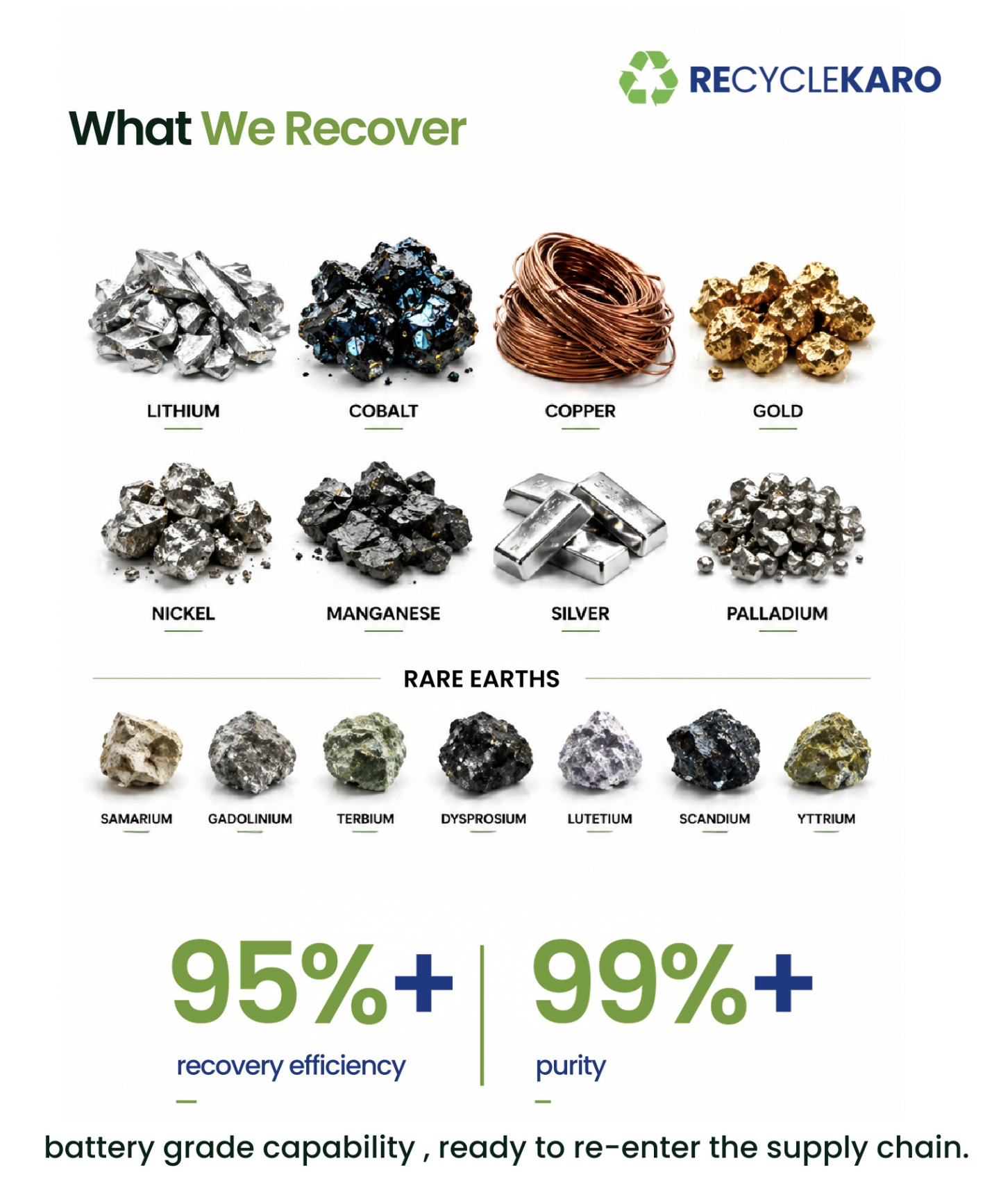
The gap between “commercially proven” and “achievable in a lab” matters here: recovery of copper, gold, silver, and cobalt from e-waste is well-established at commercial scale in India today, while recovering rare earths specifically at that same scale is still an emerging capability that a small number of Indian players are actively building out.
What are the environmental and cost trade-offs versus primary extraction?
Recovery avoids the land disturbance, tailings management, and radiological waste handling associated with mining rare earth ore, since monazite-associated thorium and uranium never enter the recovery stream in the first place.It also shortcuts the years-long permitting and construction timeline of a new mine.
The trade-off is feedstock volume and consistency: a mine produces a predictable, concentrated ore stream, while e-waste-derived feedstock is dispersed, variable in composition, and dependent on functioning collection infrastructure which is precisely why formal collection networks and EPR compliance matter as much to rare earth security as the extraction chemistry itself.
What Government Policies Support Rare Earth Recovery in India?
How does the PLI scheme extend to rare-earth magnet recycling?
India’s Ministry of Electronics and Information Technology has proposed extending the Production-Linked Incentive (PLI) scheme to cover rare-earth magnet recycling, offering financial incentives to companies investing in the infrastructure and technology including solvent-extraction systems and plasma furnaces needed to recover rare earths at scale.
The move signals a shift in emphasis from primary mining alone toward secondary resource recovery as a formal pillar of India’s critical minerals strategy.
What role do BARC and C-MET play in recovery technology?
Every discarded phone, laptop, and retired EV battery in India adds to a domestic mineral reserve that already exists, it just hasn’t been captured.
Today, a large share of that material is absorbed by an informal sector that recovers only a fraction of it through crude methods, meaning the lithium, cobalt, and nickel inside it effectively has to be re-imported all over again.
How do the E-Waste (Management) Rules 2022 and EPR obligations govern rare earth recovery?
Rare earth recovery in India operates inside the same regulatory framework as the rest of e-waste management: Extended Producer Responsibility (EPR) obligations under the E-Waste (Management) Rules, 2022 require manufacturers to ensure their products are collected and channeled to authorized recyclers at end of life, and CPCB/state pollution control board authorization governs how a facility may legally process that waste.
For rare earth recovery specifically, formal EPR-driven collection is the difference between magnets ending up in an authorized recycler’s hydrometallurgical line versus being stripped informally and lost to the formal supply chain entirely.
Which Industries Use Recovered Rare Earth Elements?
What products depend on recovered NdFeB magnets?
Recovered NdFeB magnets and rare earth oxides feed back into the same categories of manufacturing they came from: EV traction motors, wind turbine generators, industrial motors, precision electronics, and defense and aerospace components. As India scales domestic EV and renewable energy manufacturing, recovered rare earths represent a domestic materials source that doesn’t carry the same import exposure as virgin material sourced from a concentrated handful of overseas suppliers.
How do OEMs use recovered rare earths to meet BRSR/ESG and Scope 3 targets?
For OEMs reporting under India’s Business Responsibility and Sustainability Reporting (BRSR) framework, sourcing recovered rather than virgin rare earth materials contributes directly to Scope 3 emissions reduction and circular-economy disclosure metrics, alongside the supply-security benefit. That combination, compliance value plus supply security, is increasingly what’s driving corporate interest in formal rare earth recovery partnerships rather than treating it as a niche sustainability initiative.
Which Companies Are Recovering Rare Earth Elements in India?
What is the current state of India’s rare earth recovery industry?
A small group of Indian recyclers is actively building rare earth recovery capability alongside their existing e-waste and battery recycling operations, spurred in large part by the PLI scheme proposal and the broader critical minerals push.
The industry is still early: most Indian recyclers today are commercially proven at recovering copper, gold, silver, cobalt, and nickel from e-waste, with rare earth-specific recovery representing the newer, higher-difficulty frontier that separates the most advanced players from the rest of the market.
What does RecycleKaro’s role in this ecosystem look like?
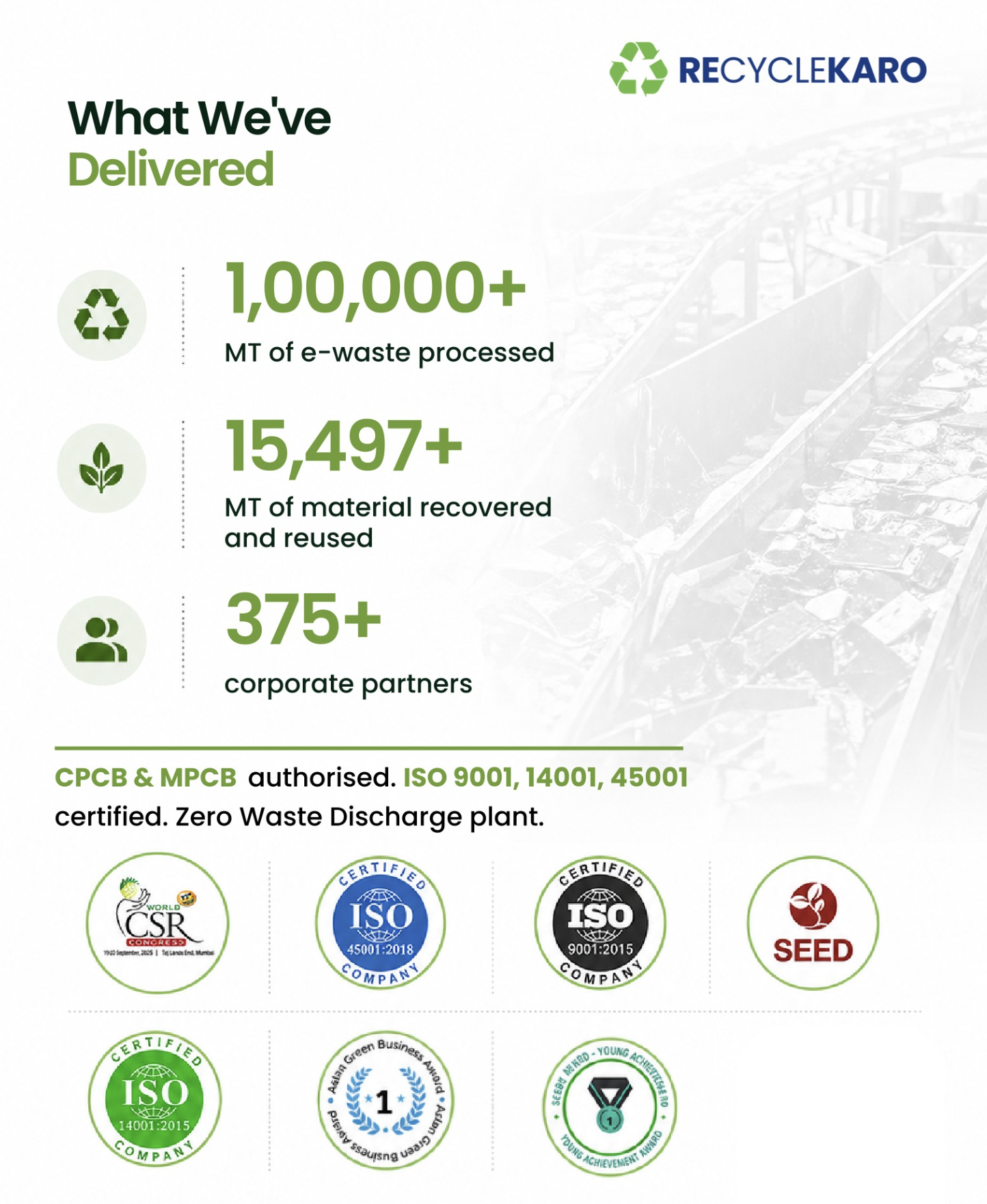
RecycleKaro operates one of India’s larger authorized e-waste and lithium-ion battery recycling facilities, with R2v3, ISO 9001/14001/45001 certification and CPCB/MPCB authorization already in place, the same regulatory and quality infrastructure that rare earth recovery requires to operate at commercial scale.
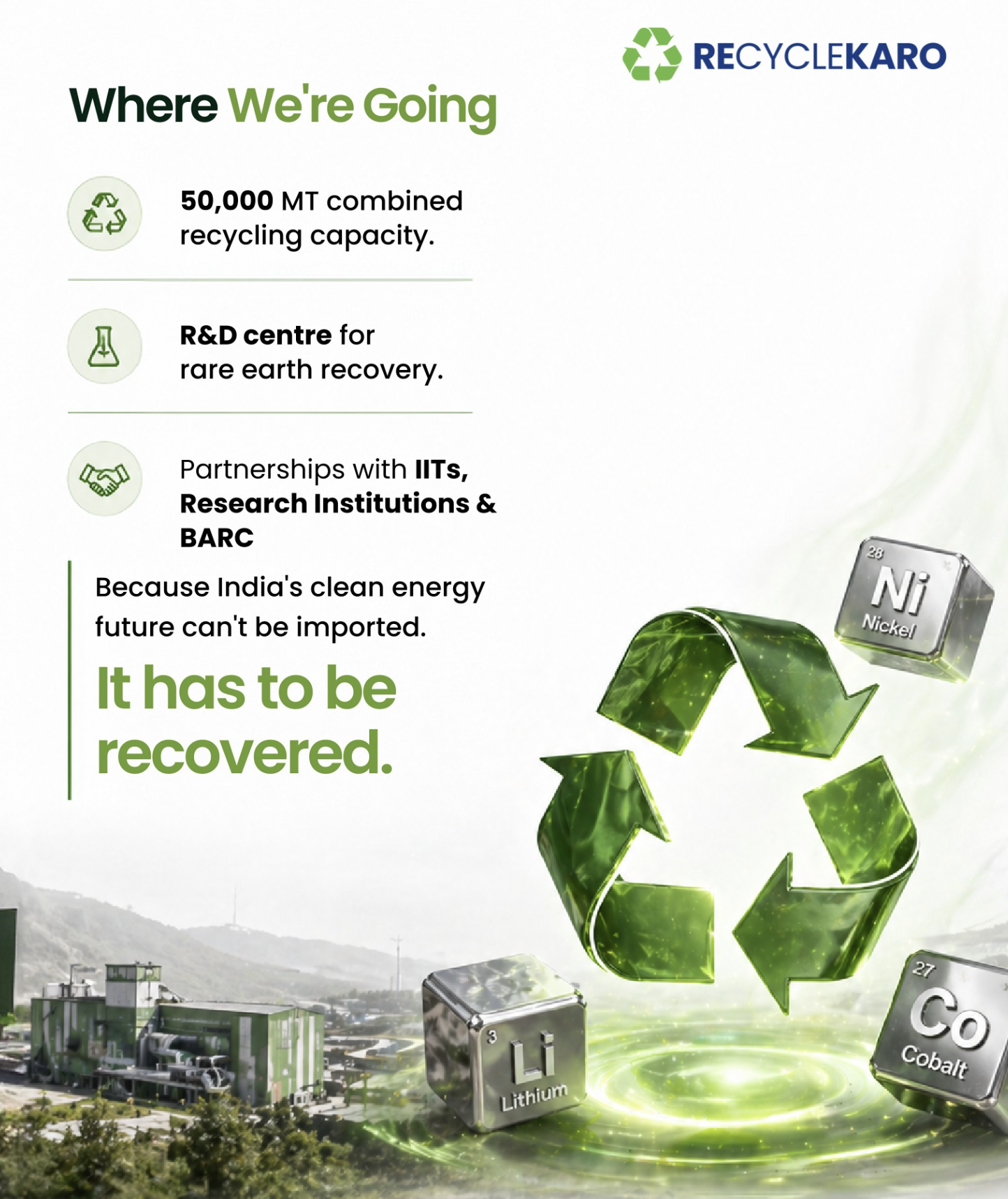
The company’s stated roadmap includes an R&D centre focused specifically on rare earth recovery and partnerships with IITs and BARC, positioning its existing hydrometallurgical and material-recovery capability to extend into rare earth elements as that segment of the business matures.