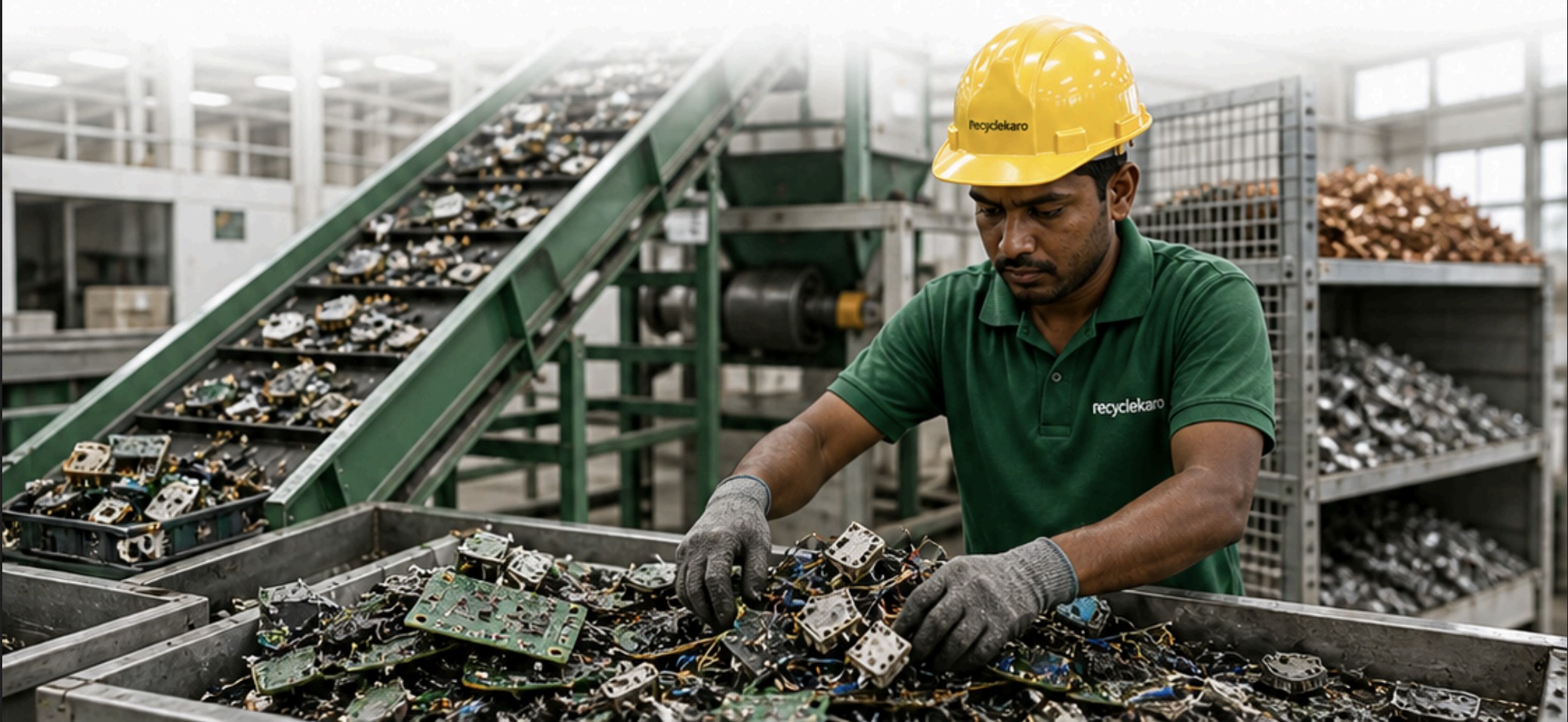
Urban mining is the process of recovering valuable metals and critical minerals like lithium, cobalt, nickel, copper, gold, and rare earth elements from discarded electronics, batteries, and e-waste, rather than extracting them from the ground.
A dead smartphone or a retired EV battery isn’t waste under this model; it’s a concentrated mineral deposit already sitting above ground, close to where it will be reused.
For import-dependent countries like India, urban mining offers a faster, lower-carbon domestic supply chain for critical minerals, one built on certified recovery infrastructure rather than years of new mining exploration.
What Is Urban Mining?
Urban mining treats the built environment, every discarded phone, laptop, circuit board, and battery pack a society has ever produced, as a mineral deposit in its own right.
The term was coined decades ago by a Japanese metallurgy researcher studying recovery from electronic waste, and gained traction across Asia as e-waste volumes grew through the 2000s.
Rather than digging into the earth’s crust for ore, urban mining recovers the same metals from products that have already been mined once, refined once, and used once and are now sitting idle in a drawer, a warehouse, or a landfill. It’s a core mechanism of the circular economy: instead of a linear path from mine to product to waste, materials loop back into the supply chain.
What is an “urban mine”?
An urban mine is the stockpile itself, the cumulative store of metals embedded in a population’s discarded goods.
Every phone that goes unused in a drawer, every laptop retired by an enterprise IT refresh, every EV battery pack that reaches end of life adds to this stockpile. Unlike a geological ore body, an urban mine grows every year, tracking a country’s electronics consumption and EV adoption rather than its geology.
Capturing that stockpile requires physical infrastructure to intercept it before it reaches a landfill or the informal sector like collection touchpoints, take-back programs, and certified processing capacity.
Urban mining vs. traditional mining – what’s the difference?
The two approaches diverge on sourcing, timeline, and yield. Traditional mining requires exploration, environmental clearance, and years of infrastructure build-out before a single tonne of ore is processed. Urban mining sources from waste streams that already exist today, inside a country’s own borders.
|
Dimension |
Traditional Mining |
Urban Mining |
|
Source of material |
Geological ore deposits |
Discarded electronics, batteries, e-waste |
|
Timeline to production |
Years (exploration + clearance + build-out) |
Immediate – feedstock exists today |
|
Metal concentration |
Ore-grade (naturally dilute) |
Often far higher than ore, per unit mass |
|
Geographic dependency |
Tied to where deposits exist |
Tied to where consumption/collection happens |
The yield gap is the clearest illustration. A tonne of mined ore typically yields roughly 1–5 grams of gold, while a tonne of discarded electronics can yield closer to 300 grams, often cited as a difference of around 60 times.
How Does Urban Mining Work?
The recovery process – collection to refined material
The urban mining pipeline runs in four broad stages:
- Collection: e-waste and batteries are gathered through take-back programs, EPR-driven reverse logistics, and dedicated collection touchpoints.
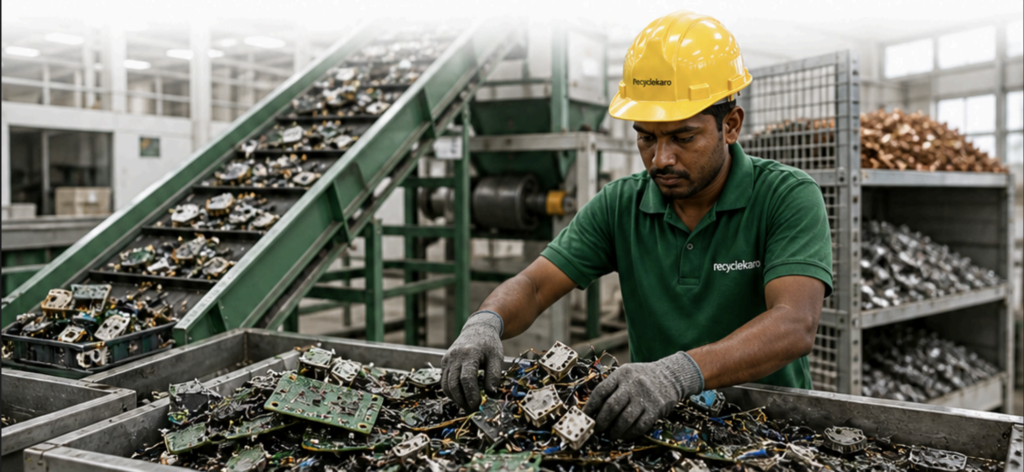
- Segregation and dismantling: devices are sorted by type and manually or mechanically stripped of components like circuit boards, battery cells, casings.
- Mechanical processing: shredding and physical separation isolate metal-rich fractions from plastics and other non-recoverable material.
- Chemical and hydrometallurgical refining: the metal-rich fraction is chemically processed to extract and purify individual elements into battery-grade or industrial-grade output.
What is black mass, and why does it matter?
When lithium-ion batteries are shredded as part of the recovery process, they produce a fine, dark powder known as black mass – a mixture of cathode and anode material containing lithium, cobalt, nickel, and manganese in far higher concentration than any natural ore. Black mass is the intermediate product that hydrometallurgical refining converts into battery-grade salts and metals, and its quality is one of the biggest levers on how efficiently a facility can recover material.
Which materials come out of urban mining?
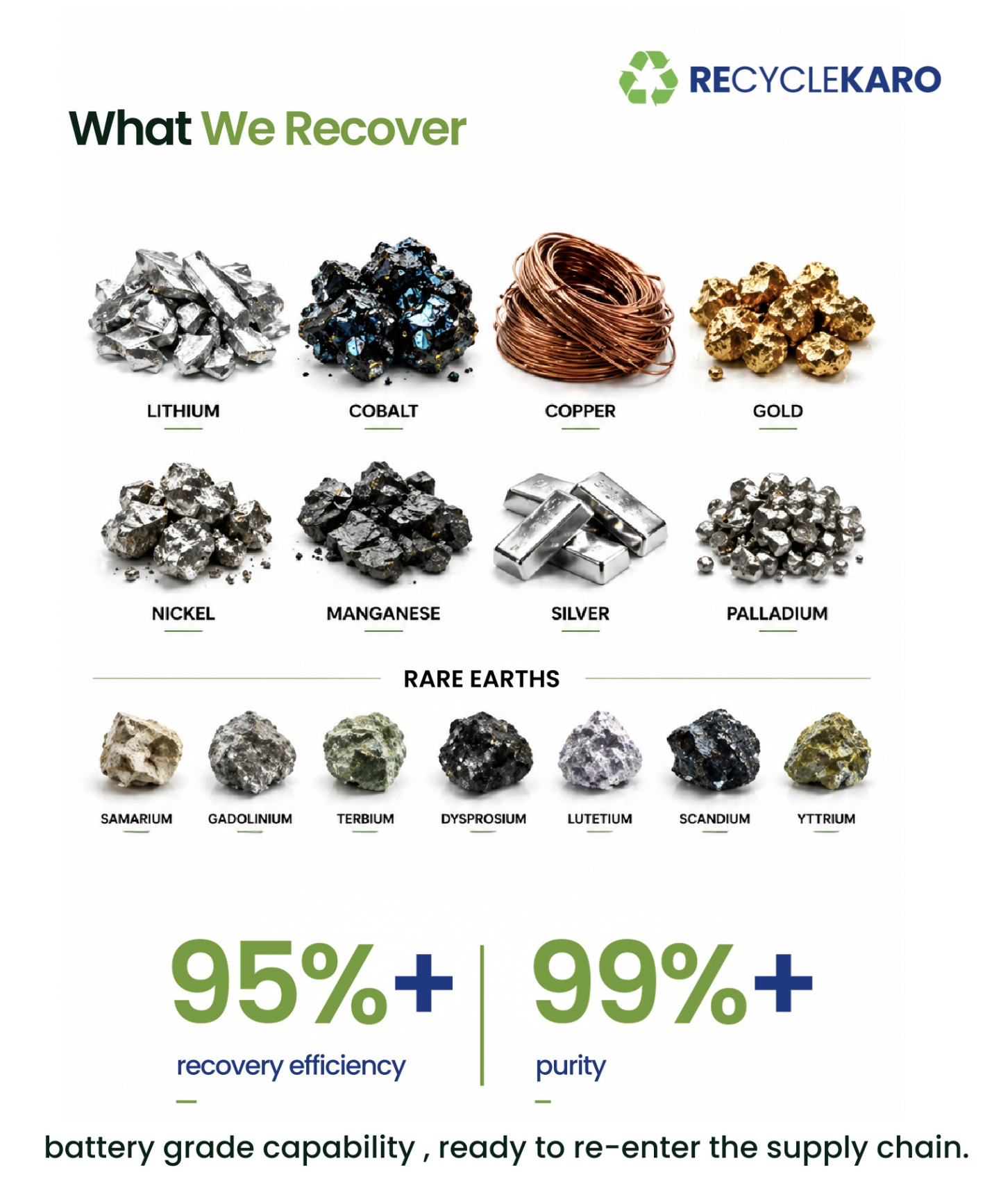
The range of recoverable output depends on the input stream- a shredded circuit board yields a different metal mix than a lithium-ion battery pack but a well-run urban mining operation can recover a wide range of metals and minerals across categories, including:
- Battery and industrial metals: lithium, cobalt, nickel, copper, manganese
- Precious metals: gold, silver, palladium
- Rare earth elements: samarium, gadolinium, terbium, dysprosium, lutetium, scandium, yttrium
Each of these has an active industrial demand curve, from EV batteries and grid storage to electronics manufacturing, magnets, and defense applications.
Is Urban Mining Better Than Traditional Mining?
Environmental and energy benefits
Recovering metal from waste generally requires significantly less energy and water than primary extraction, since the ore-crushing and beneficiation steps that dominate mining’s environmental footprint aren’t needed. Depending on the mineral, virgin mining is estimated to emit somewhere between 4 and 25 times more CO2 than recovering the same metal through recycling.
Urban mining also sidesteps a layer of exposure that primary mining can’t avoid: sourcing cobalt from conflict-affected regions, or lithium from countries that periodically restrict exports. Recovering the same metals domestically, from material already inside the country, removes that geopolitical variable entirely.
Where urban mining hits limits
Urban mining isn’t a free lunch. Its biggest constraint isn’t chemistry, it’s collection.
In most markets, including India, a large share of e-waste and battery waste never reaches a formal, certified recycler at all. It’s absorbed by an informal sector that recovers only a fraction of the available material through crude, often hazardous methods, losing the rest to inefficient processing or disposal.
Feedstock quality also varies- mixed e-waste streams are harder to process consistently than standardized battery packs, since composition shifts with device type, age, and manufacturer. And recovery from landfills specifically remains costly and technically difficult: once material is buried and mixed with organic waste, separating it back out often costs more than the recovered metal is worth. That’s why most near-term urban mining potential sits in current and future waste streams – the phones, laptops, and batteries reaching end of life this year and next, rather than historical landfill stock.
None of this makes urban mining less viable; it means its impact depends on three things working together, not on processing technology alone:
- regulatory enforcement that channels waste toward certified recyclers,
- economic incentives including EPR frameworks with real penalties for non-compliance that make formal recycling more profitable than informal scrap sale, and
- public awareness, since a meaningful share of leakage happens simply because consumers and small businesses don’t know formal recycling exists or how to access it.
How Urban Mining Powers E-Waste and Battery Recycling
E-waste as an urban mine
Consumer and enterprise electronics like smartphones, laptops, servers, printed circuit boards are among the richest categories of urban mine per unit of weight, carrying disproportionate concentrations of gold, silver, copper, and palladium relative to their size.
Lithium-ion battery recycling as urban mining at scale
As EV adoption accelerates, end-of-life battery packs are becoming a larger and more predictable feedstock than mixed e-waste.
Because battery chemistry and form factor are more standardized than the average consumer device, battery recycling is arguably the most scalable urban mining category over the next decade.
Industries already using urban mining
Urban mining already underpins recovery programs across several industries, each feeding a different input stream into the same underlying recovery infrastructure:
- Electronics manufacturing – reclaiming gold, silver, and copper from PCB scrap generated during production and from post-consumer returns
- Automotive and EV – recovering lithium, cobalt, and nickel from retired battery packs and manufacturing scrap as EV fleets scale
- Enterprise IT asset disposition (ITAD) – recovering value and ensuring data-secure destruction from decommissioned laptops, servers, and networking hardware
Read More: IT Asset Disposition(ITAD) in India - Renewable energy – recovering silver, copper, and other metals from end-of-life solar panels and inverters as early-generation installations retire
Read More: Solar Panel Recycling in India
- Defense and aerospace – securing rare earth elements for magnets and electronics without depending entirely on a handful of exporting countries
What varies across these industries is the collection mechanism – corporate take-back for ITAD, dealer trade-in programs for EVs, municipal collection for consumer electronics but the downstream recovery process converges on the same shredding, sorting, and refining steps.
Urban Mining in India: Closing the Import Gap
India’s critical mineral import dependency, by the numbers
India imports an estimated 70%+ of the critical minerals it needs for EV batteries, electronics manufacturing, and grid-scale energy storage.
Domestic primary mining can’t close that gap quickly – exploration, environmental clearance, and mine build-out typically take a decade or more before a new deposit reaches commercial production.
How much recoverable material is sitting in India’s waste streams
Every discarded phone, laptop, and retired EV battery in India adds to a domestic mineral reserve that already exists, it just hasn’t been captured.
Today, a large share of that material is absorbed by an informal sector that recovers only a fraction of it through crude methods, meaning the lithium, cobalt, and nickel inside it effectively has to be re-imported all over again.
Why urban mining is industrial policy, not an environmental side project
Framed only as sustainability, urban mining undersells its real significance. Every tonne recovered domestically reduces India’s import bill, insulates its EV and electronics manufacturing base from global price shocks and export restrictions, and builds employment across collection, processing, and refining.
It also removes a specific point of fragility: a mineral recovered inside the country can’t be cut off by an export ban, a trade dispute, or resource nationalism elsewhere in the world. The regulatory shift toward treating recovery this way is already underway:
- Extended Producer Responsibility (EPR) rules covering e-waste, batteries, and non-ferrous metals are now in force in India.
- Battery passports – digital records tracking a battery’s material composition and history are moving from an EU pilot toward a broader global standard.
- India’s Critical Minerals Mission explicitly recognizes recovery and recycling as a strategic pillar alongside primary mining exploration.
Put together, these signal a shift in how policymakers are starting to talk about mineral security, not purely as a mining and diplomacy problem, but as a recovery and infrastructure problem that can be solved faster, closer to home. The countries that move first on formal recovery infrastructure won’t just cut their import bills; they’ll set the compliance and quality benchmarks that the rest of the market has to follow.
How RecycleKaro Is Building India’s Urban Mine
Recovery efficiency and purity benchmarks
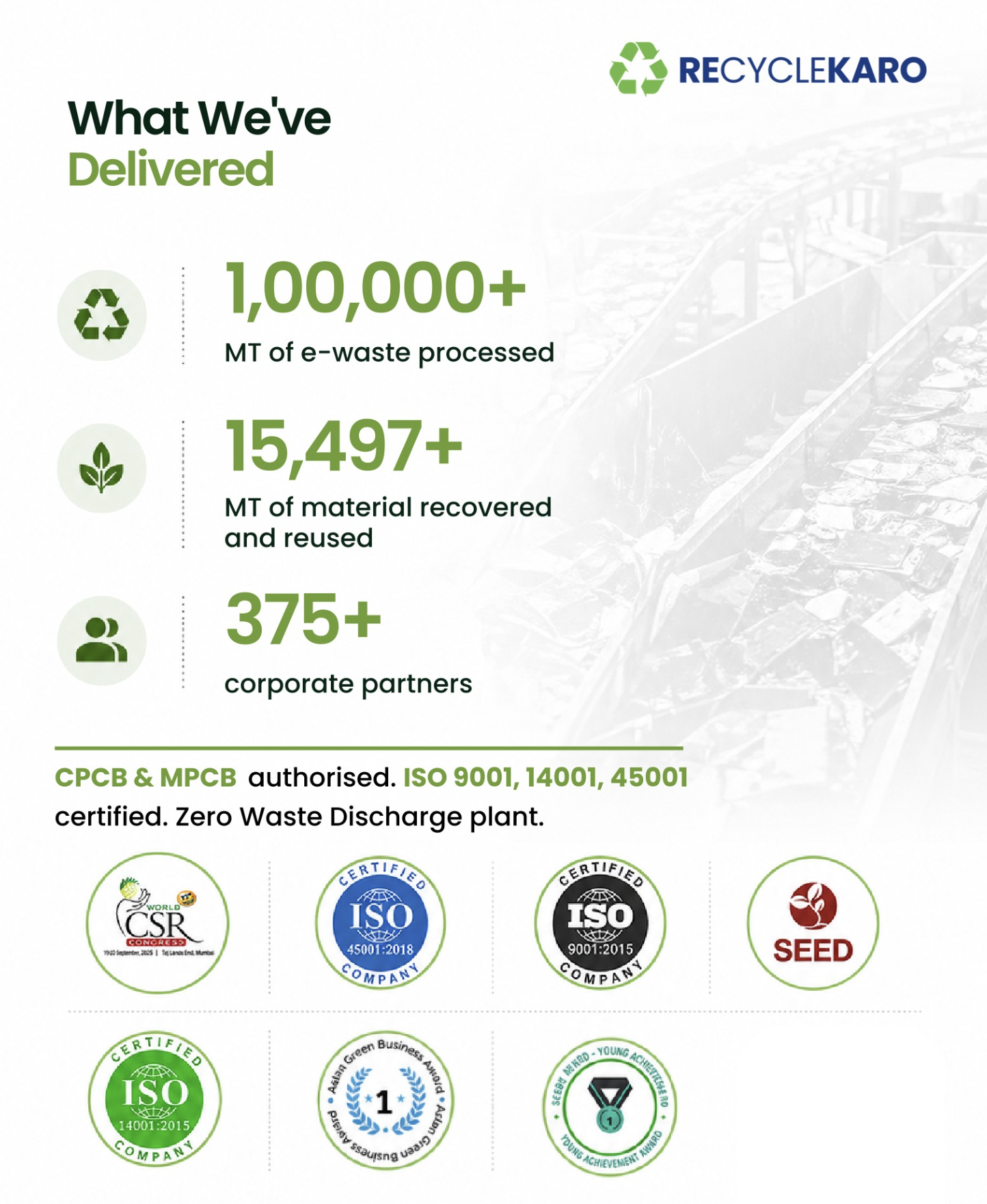
RecycleKaro operates a CPCB- and MPCB-authorized, R2v3 and ISO 9001/14001/45001-certified recycling facility in Palghar, Maharashtra, recovering lithium, cobalt, nickel, copper, gold, silver, palladium, manganese, and seven rare earth elements at 95%+ recovery efficiency and 99%+ purity, output that meets battery-grade specifications and is ready to re-enter the supply chain.
R&D partnerships and scale-up plans
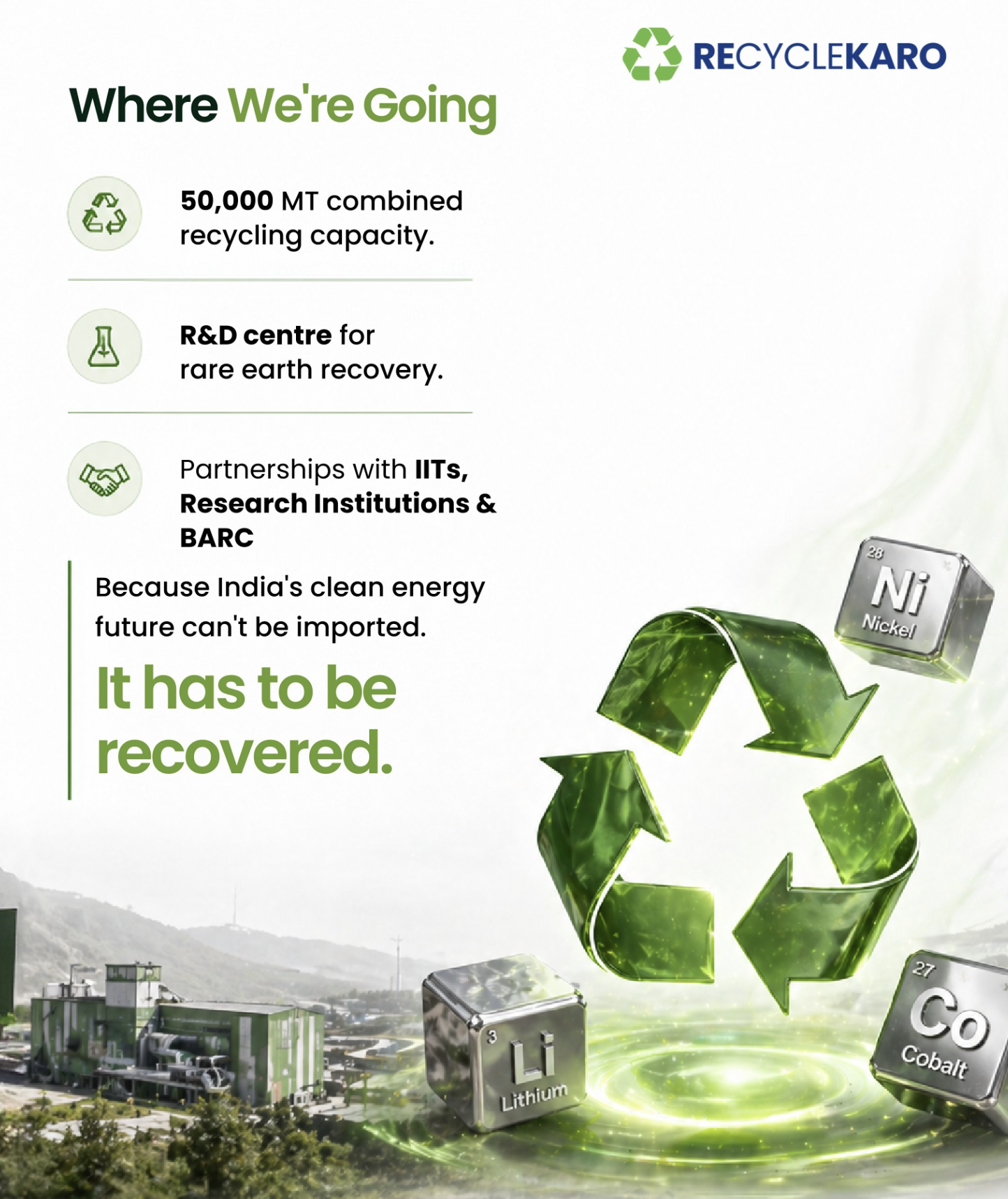
Backed by 15+ years of operating history, a 17-acre facility, 300+ employees, 12,000+ collection touchpoints, and 375+ corporate partners feeding material into the recovery pipeline, RecycleKaro is also building forward: R&D partnerships with IIT and BARC on rare earth recovery, and a stated target of 50,000 MT of combined recycling capacity as India’s battery and e-waste volumes scale.