

Key Takeaways
-
Black mass is the metal-rich powder recovered from spent lithium-ion batteries, constituting 40–50% of an EV battery’s total weight.
-
Value relies on four factors: battery chemistry, recovery pathway, output purity, and commodity prices.
-
NMC and NCA black mass contain nickel and cobalt; LFP contains neither, requiring a fundamentally different recycling business model.
-
WRI India estimates 128 GWh of battery recycling potential by 2030, yielding approximately 17,500 tonnes of lithium, 22,600 tonnes of nickel, 2,600 tonnes of cobalt, and 141,800 tonnes of graphite.
-
India’s Battery Waste Management Rules 2022 impose EPR obligations on all battery producers.
-
RecycleKaro’s Palghar facility achieves 95%+ recovery efficiency at 99.5% purity for battery-grade CoSO₄ and NiSO₄.
In 2024, global EV battery demand surpassed 1 TWh and is projected to exceed 3 TWh by 2030 [Source: IEA Global EV Outlook 2024]. Every battery manufactured today will eventually reach the end of its life. The critical question for recyclers is not just about collecting those batteries, but about extracting value from them with precision, consistency, and downstream control.
In India, black mass battery recycling sits at the heart of this challenge. As EV adoption accelerates and India’s dependence on imported lithium, cobalt, and nickel becomes a recognized industrial vulnerability, black mass has shifted from an obscure intermediate to one of the most strategically important materials in the country’s clean energy economy.
What is Black Mass?
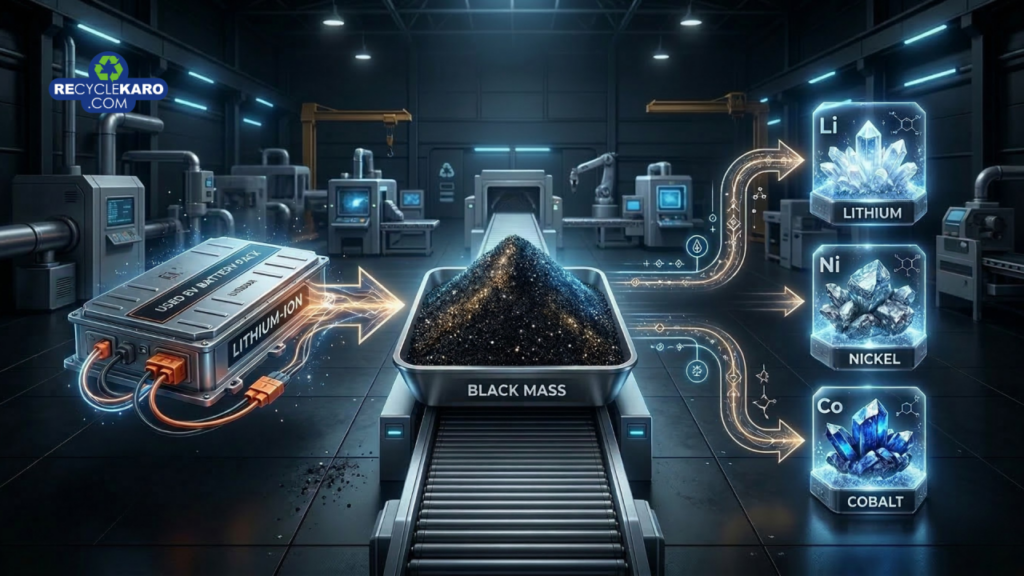
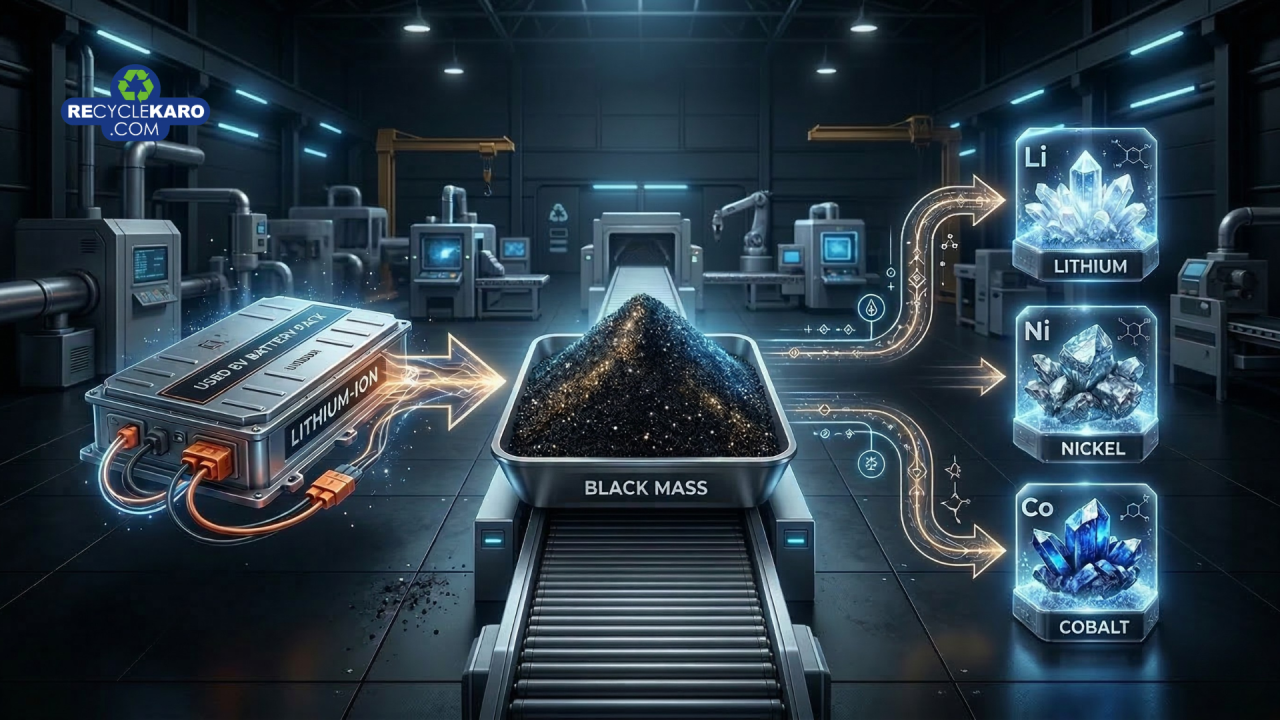
Black mass is the concentrated material fraction recovered from spent lithium-ion batteries after safe discharge, dismantling, shredding, and physical separation.
It contains:
-
The cathode
-
Anode active materials: lithium, nickel, cobalt, manganese, and graphite – essential for battery function and valuable at end of life.
Named for its dark, fine-grained powder appearance due to high graphite concentration, black mass represents approximately 40–50% of an EV battery’s total weight. The remaining materials, copper and aluminium foils, steel casing, plastics are separated earlier in processing.
For OEM procurement teams, black mass is the point at which the value of end-of-life batteries is realized or lost. For ESG directors, it is where Scope 3 avoided-emissions calculations become meaningful. For India’s industrial policy, it represents the early formation of a domestic secondary minerals economy.
Composition by Battery Chemistry
Not all black mass is equal. Metal content and commercial value varies significantly by battery chemistry.
|
Metal |
NMC |
NCA |
LFP |
|---|---|---|---|
|
Lithium |
2–6% |
2–5% |
3–5% |
|
Nickel |
5–15% |
10–20% |
None |
|
Cobalt |
5–20% |
3–8% |
None |
|
Manganese |
2–10% |
Trace |
None |
|
Iron |
Trace |
Trace |
20–35% |
|
Graphite |
15–25% |
15–25% |
15–25% |
Indicative ranges based on industry-reported data [Source: S&P Global Commodity Insights black mass assessments; RecycleKaro process data, Palghar].
The critical variable: NMC and NCA contain nickel and cobalt, whereas LFP does not. This single difference shapes everything downstream from processing pathway to business model to margin structure.
For a technical walkthrough of how each chemistry moves through the recovery process, see our end-to-end black mass recovery process guide.
The Four Forces That Determine Black Mass Value
Black mass economics is systems economics shaped by four forces acting simultaneously on every tonne of material.
- Chemistry: Chemistry sets the theoretical value ceiling. A high-cobalt NMC black mass has a higher metal value ceiling than an LFP black mass of the same weight. This is chemical reality, not a quality judgment.
- Recovery pathway determines how much of that theoretical value is captured. A hydrometallurgical operator dissolving black mass in leach solution, then selectively separating metals through solvent extraction can recover lithium, cobalt, nickel, and manganese at above 95% efficiency [Source: RecycleKaro facility data, Palghar]. Pyrometallurgical operators typically lose lithium to slag entirely. The difference between 70% and 95% recovery on a 15% cobalt black mass is not incrementa, it determines viability.
- Purity: Purity determines the pricing tier. Cobalt sulphate and nickel sulphate destined for cathode precursor manufacturing must reach 99%+ purity. A recycler that achieves high recovery efficiency but only 85% purity output is producing an industrial-grade commodity not battery-grade material and trades at a corresponding discount.
- Market Timing: Market timing indexes black mass value to commodity prices. Cobalt fell from USD 90,000/t in 2018 to below USD 25,000/t in 2024 [Source: LME cobalt price data]. Lithium moved from USD 80,000/t in late 2022 to below USD 12,000/t by 2024. Recyclers with no downstream integration or offtake certainty absorb this volatility in full. Those with integrated refining and long-term supply agreements are structurally more resilient.
LFP vs NMC Economics
India’s fastest-growing battery chemistry is LFP preferred in two-wheelers, BESS applications, and commercial EVs for its lower cost, thermal stability, and cobalt-free composition. That shift creates a direct challenge for black mass recyclers because LFP and NMC recycling are fundamentally different businesses.
|
Factor |
NMC / NCA |
LFP |
|---|---|---|
|
Primary value driver |
Nickel + cobalt recovery |
Lithium recovery + scale |
|
Margin sensitivity |
Commodity price cycles |
Operating cost and volume |
|
Business model |
Metal value + process efficiency |
Scale + cost discipline |
|
Graphite recovery |
Important, secondary |
Important, secondary |
NMC recycling economics are driven by cobalt and nickel value. LFP recycling depends on lithium recovery efficiency, graphite monetization, and the ability to spread fixed costs across high volumes. LFP recycling is viable, it simply requires a different model that rewards scale over metal richness.
As India’s EV market scales toward LFP dominance, battery recyclers who are not designing for this transition now will face structural compression within three to five years. For OEM procurement teams: ask not just whether your recycler can handle today’s NMC feedstock, ask whether they are built for the chemistry mix of 2028.
India’s Black Mass Opportunity
India imports most of its battery raw materials. Lithium from Australia and Chile. Cobalt from the DRC via Chinese refiners. Nickel from Indonesia and the Philippines. This dependency is both a cost issue and an industrial resilience issue.
Black mass recovery represents a path toward domestic supply. WRI India’s analysis quantifies what is at stake [Source: WRI India, Battery Recycling in India, 2022]:
|
Material |
Estimated Recoverable Quantity by 2030 |
|---|---|
|
Lithium |
~17,500 tonnes |
|
Nickel |
~22,600 tonnes |
|
Cobalt |
~2,600 tonnes |
|
Graphite |
~141,800 tonnes |
India generates more than 3.2 million metric tonnes of end-of-life electronics annually, with lithium-ion battery waste growing at approximately 30% CAGR [Source: Recycling Today, March 2025]. The National Critical Minerals Mission explicitly recognizes recycling as a strategic supply source — policy intent is clear. What remains is the processing infrastructure to actualize it.
One additional signal worth noting: in November 2025, India’s apparent black mass export restrictions contributed to a record-high NCM black mass payable of 85% CIF South Korea, as South Korean buyers scrambled for supply [Source: Fastmarkets BRM Monthly Update, November 2025]. When Indian black mass is exported as raw intermediate, India captures the exporter’s margin. When it is refined domestically into battery-grade CoSO₄ and NiSO₄ – as RecycleKaro does at Palghar – India captures the full refining margin on top.
EPR Regulations and Battery Waste Management Rules 2022
India’s Battery Waste Management Rules 2022, as amended in 2025, establish EPR obligations for all battery producers – manufacturers, importers, and brand owners. Core requirements include:
-
Register on CPCB’s EPR portal
-
Meet annual collection and recycling targets proportional to market placement volumes
-
Ensure batteries are processed only by CPCB-authorized recyclers
-
Maintain chain-of-custody documentation for EPR credit verification
The 2025 amendments push EPR verification toward audit-ready recycling chain documentation meaning the EPR trail is increasingly expected to support BRSR Scope 3 disclosures, not just satisfy a compliance checkbox. For a detailed guide on EPR documentation requirements and partner selection, see our EPR battery recycling compliance guide.
How the Recovery Process Works
The black mass recovery process moves through four stages. For a full technical walkthrough including mass balance data and output specifications, see our end-to-end process guide.
Stage 1: Collection and Safe Discharge: Batteries are collected through authorized reverse logistics channels and discharged to below 2V per cell under CPCB-compliant chain-of-custody protocols. Safe discharge is non-negotiable – shredding undischarged cells creates thermal runaway risk, electrolyte vapor exposure, and regulatory liability.
Stage 2: Mechanical Preprocessing: Discharged batteries are dismantled, shredded, and separated into black mass, copper and aluminium foils, casing materials, and plastics. Sorting accuracy at this stage directly determines the chemistry purity of downstream black mass – mixed NMC/LFP feedstock degrades leach efficiency and suppresses output purity.
Stage 3: Hydrometallurgical Extraction: Black mass is dissolved in leach solution and recoverable metals are selectively separated through solvent extraction or ion exchange, then purified and converted into battery-grade salts. RecycleKaro’s Palghar facility achieves above 95% recovery efficiency at 99.5% purity for cobalt sulphate and nickel sulphate [Source: RecycleKaro facility data; Recycling Today, March 2025] meeting cathode precursor manufacturing specifications.
Stage 4: Co-product Recovery: Graphite, copper, and aluminium fractions are processed through dedicated recovery pathways. RecycleKaro operates under a zero-disposal approach all input material is recycled or repurposed.
RecycleKaro’s 7 Principles of Black Mass Economics
Based on more than a decade building India’s battery recycling infrastructure and processing over 8,432 metric tonnes of lithium-ion batteries [Source: Recycling Today, March 2025]:
1. Black mass is not the end product, it is the economic hinge point. Value sits in the refined, battery-grade materials downstream. Operators who sell black mass capture a fraction of available margin. Those who integrate into hydrometallurgical refining capture the rest.
2. Chemistry mix is destiny. NMC, NCA, and LFP produce different commercial outcomes from the same process. Design your business model for the chemistry trajectory, not just today’s feedstock.
3. Collection and sorting quality directly determine downstream profitability. Bad feedstock discipline propagates through every subsequent process step, degrading leach efficiency and suppressing purity. The recycler’s margin starts at collection.
4. Recycling margins increasingly reward process excellence over volume access. The durable advantage sits in recovery rates, output quality, and downstream integration, not in collection network size alone.
5. India must treat black mass recovery as a critical mineral strategy, not just environmental compliance. EPR compliance is the floor. The ceiling is a domestic secondary minerals economy in which India recovers battery-grade lithium, nickel, and cobalt from its own waste stream.
6. Downstream integration will matter more over time. The closer a recycler is to refined battery materials – CoSO₄, NiSO₄, lithium carbonate – the more defensible its commercial position.
7. The sector’s future value will shift toward material intelligence and traceability. Battery passport requirements, EPR verification standards, and OEM supply chain due diligence are all pushing toward credible, traceable, high-purity material. Operators who invest in process transparency now will command premium positioning as these requirements become standard.
Work with RecycleKaro
RecycleKaro is India’s largest recycled cobalt manufacturer, a CPCB-authorized lithium-ion battery recycler operating from its Palghar facility near Mumbai, with clients including:
-
Bajaj Auto
-
Tata Motors
-
Hero MotoCorp
-
Ather Energy
Frequently Asked Questions
1. What is black mass in battery recycling?
Black mass is the concentrated material fraction recovered from spent lithium-ion batteries after safe discharge, dismantling, mechanical shredding, and separation. It contains:
-
lithium
-
nickel
-
cobalt
-
manganese
-
graphite — representing approximately 40–50% of an EV battery’s total weight is the primary feedstock for hydrometallurgical refining to recover battery-grade metals.
2. What metals are in black mass from an EV battery?
Composition varies by chemistry. NMC black mass typically contains:
-
5–20% cobalt
-
5–15% nickel
-
2–6% lithium
-
2–10% manganese
-
15–25% graphite. LFP black mass contains no cobalt or nickel – its recoverable value centers on lithium (3–5%) and graphite.
3. How is black mass value determined?
By four forces: battery chemistry (which metals are present), recovery pathway quality (how much is captured), output purity (battery-grade vs. industrial-grade pricing), and prevailing commodity prices. Market participants track “payables” — the percentage of LME metal price offered for recoverable content as the primary benchmark.
4. How much battery material can India recover by 2030?
WRI India estimates 128 GWh of battery recycling potential by 2030, with recoverable resources of approximately 17,500 tonnes of lithium, 22,600 tonnes of nickel, 2,600 tonnes of cobalt, and 141,800 tonnes of graphite.
5. What are India’s regulations on battery waste recycling?
Battery Waste Management Rules 2022, as amended in 2025, require battery producers to register with CPCB, meet annual EPR collection and recycling targets, and use only CPCB-authorized recyclers. Documentation requirements are moving toward full audit-ready chain-of-custody traceability.
6. What purity does RecycleKaro achieve in black mass processing?
RecycleKaro’s Palghar facility achieves above 95% recovery efficiency and 99.5% purity for cobalt sulphate and nickel sulphate — meeting battery-grade specifications for cathode precursor manufacturing. The facility processes up to 10,000 metric tonnes of lithium-ion batteries per year and is India’s largest manufacturer of recycled cobalt sulphate.